


 Posts
Posts



wCWk~%24(KGrHqV,!h8Ew5GsnS3dBMUy3MzVPg~~_3.jpg)










Sunday, October 25, 2026
American Doll and Toy Museum: Scarecrows and Two Books by Avon Neal on the Subject
American Doll and Toy Museum: Scarecrows and Two Books by Avon Neal on the Subject: Scarecrows Elaborate Harvest Figure displayed in Elizabeth IL during a 2018 Fall Festival Scarecrow made with a plastic Jack O'Lan...


Tuesday, October 6, 2026
A Few Halloween Poppets
Leaves dance in the air trees turn color and days are shorter. Ghost and witch dolls emerge from haunted doll houses. Here are a few for you to enjoy .


Sunday, February 22, 2026
Little Houses of Ancient Times
I've been to lectures and read articles stating doll houses and miniatures in general date to the late seventeenth century with the Dutch Baby Houses, magnificent in their own right. Yet, we know Henry VII contributed to the Royal miniature collection in the late sixteenth century. Miniatures and tiny buildings and room, however, were known in the Ancient World and are often discovered in tombs even today.
A wonderful article by the Editors appeared in the March/April 2026 Archaeology magazine. The article is called "Model Homes; A Look Inside Miniature Worlds Created for the Living, the Dead and the Divine."
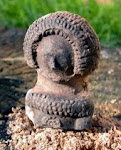
Structures covered include Ancient Egyptian rooms representing a granary and a bakery with miniature figures. I've seen one in a local museum and more figures at the Rosicrucian Egyptian Museum, San Jose, CA. There is a home for Maya God, done as a terracotta miniature, AD 700-850, a Pigpen and Penthouse from China, with tiny inhabitants, AD 25--220. Also, from central Italy, 900-700 B.C., come terracotta hut urns and a tower urn, used to contain ashes of deceased persons, usually women.
From Iran, 11-50 to 1250 AD comes a courtyard, enclosed, with tiny figures appearing to have a party. I question the editors on this one; it may be a toy. Many Islamic countries eschew human figures, statues, and photos, unless the figures are dolls, meant as toys for children. Doll collecting exists, but it is not officially sanctioned.
From Greece comes a house model 9.5 inches tall, c. 1700 B.C.
From north Macedonia, 6400-5500 B.C., come houses with human figures built on top. These are clay. They remind me of German Kitchen Dolls; the doll's skirts open up to reveal a tiny kitchen.
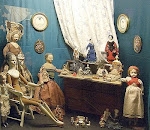
It's worth buying this issue for your files. Below are some pictures of the mini rooms and houses of American Doll and Toy Museum. Besides doll houses, we have Dept 56 homes and others, David Winter and other cottages, small souvenir buildings, dioramas, and shadow boxes.


Thursday, December 25, 2025
American Doll and Toy Museum: Christmas 2025; the State of the Doll Museum
American Doll and Toy Museum: Christmas 2025; the State of the Doll Museum: Happy Holidays, Merry Christmas and Happy New Year! The solstice has come and gone, and it is truly winter. I thought I would share some f...
Friday, June 20, 2025
Over 400,00 Strong!!
We are over 400,000 strong! Thank you. We have also picked up some new followers in our fifteenth year. I love you all and am grateful. The museum continues to grow and thrive. We will soon be expanding with over 2000 donations last year of dolls, toys, and books. We have had some financial donations which go to our building and which we truly appreciate.
Our flower bed is full of hibiscus and milk weed, along with miniature roses and bachelor buttons. A friendly squirrel runs around outside.
We have displays of dolls and toys representing prehistory to the present. We're grateful to Erin and the folks at Rescued, Pat D., and our many friends an contributors, to our Board, to my husband who does it all.
Here are some recent photos to enjoy, with more on Instagram under ellen_tsagaris.
Books update; Thinking outside the Doll House available from Austin Macaulay till June 27th. Capital Punishment in Popular Culture: Toys, Games, and Nursery Rhymes-Toying with Death, available from Cambridge Scholars Publishing, Warpaint-Ethics and Beauty available from the Ethics International Press.
Some are available in paperback, some in eBook format, also some have sample chapters on their sites and available discounts. Also check out my author's page on Amazon. Some of my books are available on Kindle, free on Unlimited.




Monday, June 2, 2025
American Doll and Toy Museum: Only two dolls?
American Doll and Toy Museum: Only two dolls?: Recently, a major public figure voiced the opinion that no child need more than one or two dolls. We won’t get into politics, but I will...


Friday, March 14, 2025
Happy St Patrick's Day
Monday will once again celebrate one of my favorite holidays. I've always worn green, or had a St. Pat's sweater. I love all things Irish and Celtic, so here are some dolls too help you celebrate.

 Child's
playhouse decorated for St. Pat's


 Boadicea, Celtic Queen


Subscribe to:
Posts (Atom)
