


 Posts



wCWk~%24(KGrHqV,!h8Ew5GsnS3dBMUy3MzVPg~~_3.jpg)









Greetings again:
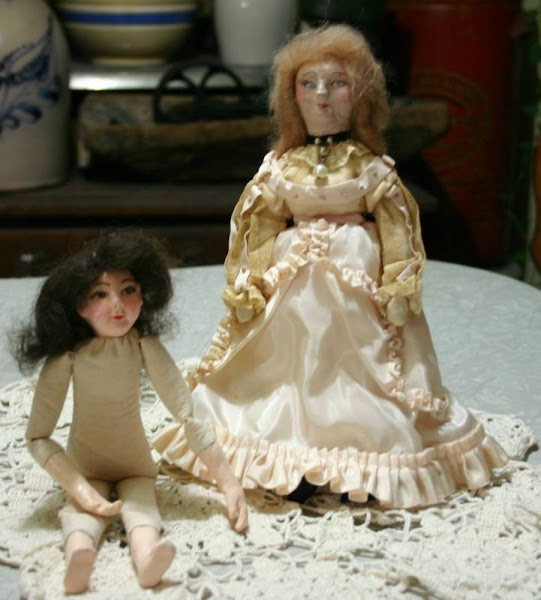
Below is one of my favorite poems by William Butler Yeats, "The Dolls." He and Rilke would have been familiar with Antique dolls of bisque, wax, and china, as well as bisque French and German Characteres, art dolls, and papier mache and composition dolls:
A DOLL in the doll-makers house
Looks at the cradle and balls:
That is an insult to us.
But the oldest of all the dolls
Who had seen, being kept for show,
Generations of his sort,
Out-screams the whole shelf: Although
There's not a man can report
Evil of this place,
The man and the woman bring
Hither to our disgrace,
A noisy and filthy thing.
Hearing him groan and stretch
The doll-maker¹s wife is aware
Her husband has heard the wretch,
And crouched by the arm of his chair,
She murmurs into his ear,
Head upon shoulder leant:
My dear, my dear, oh dear,
It was an accident.
Wednesday, April 7, 2010


Dressed Fleas from Mexico
Ah, what a cold, wet morning. Just a brief note; if anyone knows where I can buy a very reasonable example of the Dressed Fleas from Mexico; I'd be thrilled. Kimport used to sell them. More later; busy getting ready for the Girl Scouts Program.
Monday, April 5, 2010
Excerpt Chapter 3 With Love from Tin Lizzie; A History of Metal Dolls
Below is an excerpt from my book; enjoy. Sorry I'm having some trouble aligning the epigraphs.
Chapter 3
Mechanical Dolls and Automata
We pulled our dolls along behind the bars of our crib, dragged them into the heavy folds of illness. They appeared in dreams and were tied up in the disasters of feverish nights. They did not make any effort of their own; they were lying at the edge of childhood sleep, maybe filled with rudimentary thoughts of falling off,and they let tthemselves be dreamed. Just as they were accustomed to be lived tirelessly through someone else's power during the day.
Rainer Maria Rilke, "Dolls"
The machine is a material expression of the human spirit.
G. De Reynold
Automata and mechanical dolls belong in a book about metal dolls because many of their parts, including their mechanisms, are made of metal. These are the dolls and toys of which dreams are made. They are the magnificent dancing dolls of The Nutcracker Suite, and the dancing figures of Disneyland's "It's a Small World" attraction. Though they range from simple to complex, automata have origins that date back at least to Ancient Egypt. They were particularly popular in the Middle Ages. One of the earliest attempts at making an automaton was a Medieval Nuremburg crib built to contain live birds in its base. The birds' frantic attempts to escape made the figures move (Fraser 171). Also, among the earliest automated figures were those inside the Strassburg Cathedral clocktower. A mechanism allowed the figures of the Virgin and Three Wise Men to bow while a rooster moved its head and a crow flapped its wings.
Leonardo da Vinci is said to have created some marvelous mechanical figures while at the court of Lodovico Sforza, but we know of them only through his hints and through the sketches in his notebooks. The mechanical toys of Gustavas Adolphus of Sweden, however, still exist to give us a glimpse of early automated dolls. The dolls date to 1632 and dance. They are operated by a mechanism hidden under the lady's skirt. The lady has lost her head, but her male partner is still intact. The dolls are dressed in silk and gilt lace. Other early clockwork figures from this period were operated by steel springs and were called Jacquemarts (Hillier Automata 111).
Mechanical figures were very popular by the eighteenth century and there was great competition among artisans who invented them. Some examples were not automatons; instead, they were French Court dolls made of wood with hollow heads, meant to be operated manually. The information below about these dolls comes from Jean Lotz's Internet Antique Wood Doll Gallery. These figures were clearly meant for adult entertainment and are often anatomically correct. There is a cavity in the head which opens. Former curator for the Museum of the City of New York and doll collector, John Noble, suggests that a cabbage could have been placed in the cavity as a joke. Lotz claims that the compartment could also contain miniature scenes, or tiny gifts and jewels. The author has read of example in various books that were used as spy dolls, even as late as the American Civil War. Marie Antoinette and the Princess Lamballe supposedly had an example. Considering what happened to the heads of both of these ladies, the fact that their dolls heads opened and were empty is a little ironic.
One famous doll eighteenth century doll is the Dulcimer player. Invented by Roentgen and Kintzing, it dates from 1780 and is supposed to have belonged to Marie Antoinette. The dulcimer player was so popular, that the composer Glück composed special music for her. In the author's opinion, she is the forerunner of modern computerized dolls such as Pamela, Julie, Cricket, Teddy Ruxpin, Computer Interactive Talk with Me Barbie, and others. Another doll made in 1764 appears to play the guitar. While she plays, she leans forward. As is the case with many of these early automata, a complicated mechanism that moves on a wheeled frame is hidden under her skirt.
Another famous figure is the clavichord player, circa 1774, by Jaquet-Droz. Today, this amazing doll is in the Museum of Art and History in Neuchatel, Switzerland (Valentry 71). The clavichord player actually plays the keys of her instrument, and her chest rises and falls, as though she were breathing (74). Anyone familiar with the modern Mme. Tussaud Sleeping Beauty will be amazed at the similar effect in the clavichord girl. The clavichord player was made by the now famous father and son team known primarily for being clock makers (72). According to Duane Valentry in his essay "The Impossible Dolls," it was the son, Pierre, who made the doll. He allegedly called automated doll-making his hobby and referred to it as "picturesque mechanics" (73). And, picturesque these dolls certainly are. Pierre was apparently interested in realism, and he strove to make his creations as life-like as possible (73). Valentry writes that Pierre's biggest challenge was to install the sophisticated mechanism needed to make the dolls perform into the relatively small doll bodies. Valentry says that the younger Jaquet-Droz "worked his problems out cleverly, using two sets of wheel works and devising a system that set these alternately in motion without interruption until the last gesture" (74).
Pierre's doll called "The Artist" took two years to finish; the doll can draw a rabbit, dog, and child, with the doll's eyes following each stroke of the pencil, as if it were concentrating (Valentry 74). This doll, too, is famous today. The doll has a wooden heard, torso and limbs. He wears a wig and has realistic eyes. He is approximately 27 inches high. According to Alfred Chapuis and Edmond Droz, the boy "dips his quill in an inkwell on his right, shakes it twice, puts his hand at the top of the page and then pauses" (74). Further pressure on a lever makes the mechanism move, and the boy begins to write. Today, there is a mechanic on duty to ensure that the automatons of Neuchatel will endure another 200 years (Valentry 74). The Jaquet-Droz dolls were part of an exhibit at the Smithsonian in 1961 (Fawcett 50). Accompanying them was Edmund Droz, descendant of their creator, and professor of mathematics (50).
If dolls can play instruments, draw, and breathe, then they can certainly perform everyday functions like eating and walking. Chronologically speaking, walking dolls seem to be a fairly modern development. Yet, they appeared even earlier than talking models. One engraving dated 1743 shows a doll walking across a floor as a room full of delighted people watch (Hillier DDM 113).
One interesting variation on the walking doll is a rare example pushing a three wheel carriage. One thing that makes this toy so unusual is that the maker himself provided a small doll occupant for the carriage. About eleven years ago, the author saw such a doll at a doll show in St. Charles, IL. The doll was eight inches long with a rubber head. The molded blonde hair was held back with a band in the style of Alice in Wonderland. The features were painted. A small necklace with a cross was painted around the neck. The arms were also rubber. The torso and legs were made of a series of metal links, chained together. The dress was tattered gauze that may once have been blue. In bad condition, and without the mechanism or carriage, this 1850's doll coast $500.
John Noble shows variations of this type of figure in his book, Dolls. On August 25, 1868, W.F. Godwin of East New York took out a patent, No. 81, 491, for an "automatic toy." This doll had a papier-maché head with metal hands and feet with swivel ankles. The hands were made to fit around the handle of a doll carriage that it either pulled or pushed. Originally, this doll may have belonged to the Amana Society, a religious sect that still makes its home in Amana, IA (Young 140).
Walking dolls either pushing carriages or carrying things continued to be popular through the end of the nineteenth century. Alexandre Nicholas Théroude made dolls in Paris between 1842-95 (Coleman I 614). He specialized in mechanical dolls. He advertised as early as 1843 that his dolls were sent even to the French provinces and abroad (614). In 1849, Théroude won a bronze medal at the Paris Exposition. By 1852, he was trying to make his dolls even more realistic, and received a French patent for an internal mechanism which would give his dolls sound and movement. He must have been successful, for in 1855, he won a silver medal for his efforts at the Paris Exposition (614). He also won prizes at the 1862 and 1867 London and Paris Expositions, respectively (614). All his success made him cocky, apparently, for in 1856, he began to brag he invented the "talking" doll, which is not really true. The heads of these dolls were composition, with pupil-less glass eyes, and upper and lower rows of bamboo teeth. Because of the teeth, they look as if they are baring their fangs at someone. The dolls walk by way of a mechanical device with wheels on which their feet rest (Coleman I 615).
A French Christmas toy catalog from 1875-1876 shows a small doll representing a uniformed young man mounted on a four-wheeled platform. He carries a balloon with the words "Louvre" written on it, thus advertising a famous department store of the time. His arms are full of toys, including a wrapped box, a Polichinelle clown, and a tiny toy dog. He is called in the catalog, "Le Groom Des Grands Magazine Du Louvre" (Theimer 11). In this example, the child pulled the wheeled figure on its platform to make it "walk," thereby providing the mechanism. This is probably not a true automaton, then, because no motor or mechanism allows the doll to move on its own power. One might think of the difference as one between a horse and buggy or trailer pulled by a car, and a motor vehicle of any kind which operates with its own mechanical force.
Those that Got Away!
Today is beautiful and clear, with a cool, crisp feel in the air. Yet, there are threats of tornadoes, hail, plagues of locusts, you name it looming for this evening. The hard rain last night did not kill my geranium or other plants, and there was no flash flooding, thank goodness.
Today's blog is a brief one of rather sad subject matter. Like those who fish, we who collect enjoy discussing out of some morbid, masochistic ilk, "The one's that got away!" We should all keep journals of the cliches connected with collecting, including "strike while the iron's hot," which is my favorite. Below are a few of those that "got away" from me. Don't feel too badly, though, I've found more than adequate replacements to represent them, and the hunt is always on for the next available "desired object:"
1. 16" wood and papier mache doll with molded hair and orange boots. The body was jointed at five points and all wood, the features and hair molded and painted. I was at the San Jose Doll Show about 20 years ago. The doll was a little high at the time, and came from a collection in Argentina. It was a good doll, and I've since read articles about her, though the name of the doll and brand now escape me. I went around once, as is my bad habit when considering an expensive purchase. When I returned, someone else had it in hand. It was clearly over. I was able to buy a nice china head from the Argentinian connection, but I still feel a few regrets.
2. French bisques- when I was very small; I knew what a Bru and Jumeau were by the time I was seven because I had struggled through John Noble's "Dolls." After the age of five, I could identify an antique bisque doll. I viewed my first example at now defunct Fantasyland in Gettysburg, PA. French bisques and fancy chinas were available for anywhere from $50.00 to $500.00 when I was in school, K-12. Ralph's antique dolls used to bring amazing examples to our local antique shows. I even stumped Santa one year by asking for an antique Bru, but $500.00 for a doll for a nine year old in the mid-sixties was unheard of. Ralph did have a 3" all bisque with a red haired wig, class eyes, and open mouth I fell in love with. She was dressed in a little bonnet and white christening dress. All these years, I still remember that doll.
3. Unmarked Bru of white bisque. This was an unmarked lady Bru, as pictured in Mary Hillier's "Dolls and Dollmakers." She was at the Lasalle-Peru Doll Show over thirty years ago for $95.00. Again, we didn't have enough funds.
4. Dozens of Frozen Charlottes for $5.00 each at the old Black Hawk antqiues. There was even one in a perfume bottle. I was ten and didn't ahve $5.00. We were going to return but never did.
5. German bisque dressed as red-satin Harlequin in The Old Curiosity Shoppe, now gone. I think now it was an A and M, dressed in a red-satin Harlequin type outfit without the patterns. It was $28.00, and a smaller version of the the German bisques then popular.
6. A metal head baby alleged to be a Minerva and hand-carved puppet made by the owner of the Minerva. We had, as they say, "spent our wad" on a Schoenhut, and didn't have the extra $80.00 to cover both.
7. A bone or walrus ivory faced Eskimo at the gift shop of the Peabody museum. I wrote to them, but they denied having such a thing. They did. There was a whole family of them. One would have thrilled me.
8. A closed mouth German doll, in bad shape, but with original dress. It's my fault for hesitating. I went back the next day to retreive the doll, but the owner of the Mall would not sell it to me. She claimed another dealer was buying it, but the doll was not marked sold. I never went back to that antique mall.
9. A gorgeous Marin historical doll representing a woman in a Goya portrait from Madrid. I had to buy the 14th Century doll, Jimena, because the shop owner didn't want to get the Goya doll out for me. Years later, I bought the Goya doll from a friend in Galena.
10. Bisque heads, probably German, from The Monastiraki, flea market, in Athens. We just didn't know any better.
11. Bisque headed Pierrot, probably Verlingue, Madrid 1981. It was the equivalent of $38.00, and a litte pricey for a travelling student. Again, I returned the next day. The doll was gone, but the shop keeper told me it was actually over $300.00 and sold for that amount. I know my pesetas; don't think that was correct. Also, there were handmade dolls at The Madrid Flea Market I wish I had brought home.
12. Rome 1969: There was a shop full of dolls near the Trevi Fountain. There were Furga dolls that were over three feet tall. I bought a small marioneete of Raggedy Ann and some Lenci dolls, but those big beauties stil haunt me. Nevertheless, I didn't come home empty handed from that trip! Also, there were the many gorgeous French dolls at Orly Airport. There were some that appeared to be made from Skipper molds, but they were celluloid and dressed in rich 19th century costumes. I did get some other dolls, but the whole display there was breathtaking.
But, enough "sad stories." What I learned is that there is always another doll. I don't enjoy having a doll I'm interested in snatched right out from under me, especially when one of my friends does it, but I don't collect for the competitive aspects. I always find something else I like. The moral of the story is go alone on doll hunts.
Happy Dolling! Till next time.
Sunday, April 4, 2010
Thems the Breaks
It is Easter Morning 2010. We are a little cloudy, and as is, perhaps, biblically fitting, it rained on Good Friday, but there was no storm and earthquake, though Tuesday is the anniversary of the San Francisco Quake. In 1990, on April 6th, we who lived in California had aftershocks from the October Loma Prieta Quake at the very moment the 1906 quake had struck. There were still survivors alive then, and they were having a memorial and were very surprised. I have a doll from the Bay Area that allegedly survived the quake. She came from Indiana Antiques in San Jose, which used to be very well known for their wonderful dolls. Visiting them was like visiting a museum. I was lucky enough to get the Earthquake China Head, as I call her, and some other small dolls from them.
I guess when I think of earthquakes and Breaking easter eggs for good luck, which we do at church, I then think of dolls that have been cracked or broken, but that still serve a purpose. Of course, I have dolls with real eggs for heads. They are delicate, and have to be watched carefully, lest they really "crack up," but some are now forty years old, and they are hanging on fine. My mother and I also collected Ukrainian eggs and other fancy decorated eggs. We loved the ones with scenes in them, and I used to love to paint designs a la Tasha Tudor on them. We started making Easter trees from branches when I was in kindergarten, and we never really stopped. My friend Bev in San Jose made spectacular Easter trees at work, decorated with almost every type of egg design imaginable. She made almost all of them, then shared her leftover materials with me. Her trees were about five feet tall with lights and surrounding scenes. Mine were strictly table top variety, but I loved the lights and little wooden ornaments.
Small doll heads that are either broken at the neck or badly cracked have proved to be very popular with mixed media artists and collage artists. I love to use them, too,and have made some into pins and jewelry for the last 20 years. I have a barrette decorated with Frozen Charlottes in various stages of disrepair that is charming, but I'm too afraid to wear it. The trouble with this kind of art is I can never find a good, strong glue for everything!
When the Wall came down in Germany, many of the old doll factories came to light again. According to Puppentour and many witnesses, there were discarded heads and shards from bisque dolls lying on the ground. Tour guides allowed them to scoop up as many as they could carry. Maybe it's a good thing I wasn't there. I fear I would have a nervous breakdown trying to gather them all, and then would never clear customs. I'd have to mortgage everything to ship them home, etc. More likely than not, many of these were purchased at reasonalbe rates. Many are showing up on eBay and Etsy and they are selling well.
Mom and I loved our little "broken heads," and headed out for many an antique show and doll show to find them. Some came from old dumps, and were dug up by bottle collectors. In grad school, I met a minister who used to dig them up for a hobby. From him I bought many, many treasures, including some very nice old bottles and nearly complete china dolls. Another young, innocent guy told me that he sold and gave some to his mother or aunt, who then made them into dolls and sold them for "thousands," well, thousands of pennies, maybe.
Still, I've seen the prices of damaged but fixable heads climbing recently, probably because of the craft market for them. One dealer in Alto Pass, IL, didn't sell his shards and fragments. Instead, he used them fill wall space he had created with plexiglass. He was surrounded with them. Anyone who has seen "How to Make an American Quilt" remembers the walls in Anne Bancroft's "infidelity" room where she plastered heads of figurines she smashed into her wall to remind her husband of how unfaithful he had been.
We bought our first damaged doll head in Gilroy at the flea market, and my mom called her "the little burned head" because it was obvious she had been in a fire. She was a small A and M 370, as many of these are. We dressed her in Victorian eyelet with leg o'mutton sleeves and a wig of long, red banana curls. We found her small, grey glass eyes, and were realy thrilled with her. Another time, we found a Small, French head with pierced ears along with a wooden frame for a body, an old cloth body with limbs, and a pair of arms. I got at least three dolls out of that cache.
I want to have a museum display devoted to these "fabulous fragments" as I call them, and that will be the name of my Museum Gift Shop. I have been collecting unusual figurine heads as well, and unusual hand carved limbs and cast lead arms. It sounds goulish, but no more so than any good doll hospital. I always loved fixing dolls, though I'm just an amateur. These little fragments let me have an example of a great antique doll that I could otherwise not afford, and let me learn about making and repairing dolls, too. I picked up a carved Milliner's model this way, a fragment of a Jumeau fashion head with the red label stamped on the back intact, JDK Hilda [2 of them, one not broken], several more French heads, many rare and beautiful china heads, including a lady with a snood, and a whole dynasty of Frozen Charlottes, some very large. Carl Fox likened these little Charlotte fragments to the Venus of Willendorf figures, the 40,000 year old artifacts which are really the first dolls.
Over the years, I loved taking them out and rebuilding shoulder plates with plaster, and sometimes filling in "ouchies" with Play Dough or sculpey. My mom was very good at dressing them with hand knitted or crocheted outfits, or sewing of the smallest design. I learned from my friend Violet how to make bodies, and even to restring, though I could never get the same tension she could. I used to make wigs out of goats wool [Dr. Scholl's] and craft hair which got very elaborate. We dressed one old china head like Lady Macbeth, and another like Boadicea. Violet, who loved me like her own grand daughter, used to give me the "mistakes" from her kiln because in part, she liked to see what I could do with them. I used waterbased paints on some that have held up now for nearly forty years.
So, never underestimate or ignore "lucky breaks." They are a great way to teach kids about antique dolls and doll repair, and for collectors who hav a little bit of Beth March in them, they are a wonderful hobby in themselves.
I hope everyone has a blessed Easter. I hope to add a few doll stories next.
Wednesday, March 31, 2010
A Few More Favorites
Welcome to spring, finally! I have a few daffodils peeping out in my garden; I don't feel so bad about the neighbors across the street who have whole flower beds blooming already. I have a banged up organge chair I like to keep out with flower pots that is already in its appointed place. I decided to plant orange, red and yellow flowers in different shades to accent it. If my house isn't House Beautiful inside, maybe my yard has a chance. My friend next door and I also like to plant gourds and pumpkins. In part, of course, because the doll creating possibilities are endless. We are going to rotate the soil because we had no luck gettting them to reseed last year. Of course, we had a deer invasion, which didn't help.
Today, I thought I would pick up on another set of books that I have found very useful. These are Pat Smith's guides on various types of dolls, including her hardbound set on modern dolls which first came out in the mid-70s. For those in the doll business, I suspect the books were a godsend; the value of modern dolls went up and up, though online auctions have hurt them in the last year or two. I enjoyed seeing many of the dolls in my collection portrayed, and was inspired to label and organize my dolls. I make a quick and useful inventory of my most used doll books by putting a foil star next to the doll in the guide that is like mine. I write in red pencil the date I bought or acquired the doll. I also try to write the name of the person it came from. If the doll is a reproduction, I put an R by the other data that I've written. It isn't an expert way to keep inventory, but it is a start.
Smith also wrote and compiled books about antique dolls, asian dolls, French and German dolls in particular, and price guides. Two other authors have since consecutively picked up writing the price guides. Pat Smith got a little snappy with me one time on the old AOL Hobby Central; I said something nice about Eleanor St. George's books, and Pat disagreed. Well, in the immortal words of Sly Stone, "different strokes for different folks." I forgive her. Her books are great sources of information.
When I got to Independence, MO as a teenager, I saw some of the dolls in her book displayed. They belonged to people who had contributed to the Modern Doll texts. That was a great trip, except that Kimport Dolls was closed for vacation. Shortly thereafter, Mrs. McKim passed away, and they closed the doll business. Kimport is still alive online and is selling sewing patterns, just as they did when they first went into business.
More tomorrow, but it might be fun to start compiling an informal library and inventory of doll books and sources to use. More about this later.
Till we blog again.
Tuesday, March 30, 2010
Toys Soldiers
As promised, below is an excerpt from my book on Metal Dolls. Enjoy!
Chapter 2
Toy Soldiers
In the First World War soldier dolls and tin
soldiers sometimes served in the chauvinistic and militant training of the young. The spirit of war
entered the nursery.
Manfred Bachman
Dolls the Wide World Over
Millions of children throughout the centuries have enjoyed fighting mock battles with toy soldiers. Little boys and girls have long saved their pennies and pocket money to buy small figures of lead and tin with which to people their dreams of heroism nd glory. In fact, the Brontë children's earliest literary endeavors were stories that they wrote about a set of toy soldiers that belonged to Branwell Brontë. Much has been written about the dangers of war toys, including soldiers. Yet, all the criticism does not seem to quell interest in them. One wonders why this is so; recent films including Apocalypse Now, The Killing Fields, Platoon, and Saving Private Ryan have accurately, perhaps too accurately, portrayed the horrors and senselessness of war. In the same light, many novels like Stephen Crane's The Red Badge of Courage and Wilfred Owen's poem "Dulce et Decorum" have also done much to debunk the romanticism of a soldier's life. Yet, children still adore toy soldiers. Some may claim that playing with war toys is cathartic because such play allows children to act out their aggressions in harmless settings, while others may seek to foster courage and patriotism through soldier play. One need only think of Lovelace's famous poem, "To Lucasta on Going to War" and its famous line, "I could not love thee so, dear, loved I not honor more."
At least one teacher I know who is an expert in children's literature has implied that war games, and even violent play, are an innate part of childhood. She has observed that, even if one takes away all toy guns from a little boy, he will chew a peanut butter sandwich into a gun, point it, and shout, "Bang! Bang!" Whatever the reason for their existence, however, toy soldiers, particularly of metal, are here to stay, and are more popular than ever.
The earliest model soldiers were probably made of wood. They represented Prince Ensah's guard and date to the twelfth Egyptian Dynasty, 2000 B.C. Like other dolls, the early toy soldiers were not meant to be toys. Rather, they accompanied their deceased owners to the underworld. One historian has said that model solders were not really popular in the Ancient world, (Alberini 5), but he then cites a Roman legionary made of tin from the Imperial Epoch (6). Also, a fifteen inch bronze model of an equestrian survives from ancient Greece. Flat lead soldiers existed in Rome in the third century A.D. The most famous model soldiers of recent times are probably the life-sized army of Chinese figures which numbered in the thousands and once adorned an emperor's tomb. These are currently reproduced as clay miniatures and may be purchased in many import and specialty stores.
As toys, model soldiers first appeared in the Middle Ages (Fawcett 215). Of these, Leslie Gordon has said that "[e]xcept for the ancient 'magic' doll, it is possible that the toy soldier, who made his first appearance in Europe in Medieval times, was the first doll to be made of metal" (43). Some of these soldiers may have had model accessories and buildings. For example, there is a four inch wooden model of the Bloody Tower of the Tower of London which may have belonged to the Little Princes murdered there. One author speculates that this model had little figures, perhaps made of metal, to go with it (Garrat 12). Such a concept is not hard to envision; even ancient dolls had tiny dishes and other accessories with them, and companies like Playskool and Lego, manufacturers of educational playthings, make toy castles complete with knights and guards.
Interest in toys that teach is not unique to our century. In the fifteenth century, historical model soldiers first appeared. Marie d' Medici is supposed to have had silver toy soldiers made for her son, Louis XIII (Alberini). As an adult, Louis supposedly melted them down to fund his wars (6). Bronze-cast tournament toys existed as early as 1490 and the Kunst Historiches Museum in Vienna has several examples. Also, the toy museum in Salzburg has a large collection of toy soldiers and model figures. One group represents five members of the ski patrol. They are complete to their clubs, rifles and ski poles.
Another group from the Salzburg Museum represents an open carriage with two, well-dressed passengers. The driver and his groom wear plumed helmets and the horse are white. The entire piece is well- painted and appears to be beautifully preserved. Still another interesting arrangement represents a group of jockeys. Part of the display includes dice, coins, and other paraphernalia of gambling. In the background is a flier explaining the steeple chase.
Some of these early soldiers and models were breathtaking in detail. One incredibly intricate lead musketeer is French and dates from about the time of Henry IV. It stands three inches (Garrat 13). At Cluny are two Medieval knights made of tin. Some of the Cluny soldiers were worked in gold and silver decorated with enameled bronze (Harris 8). A similar ship with soldiers in the Victoria and Albert Museum is German in origin. One of these ships represents Charles V and his court moving on deck (8).
By the early sixteenth century, some model and toy soldiers were on rollers and held miniature lances. The eighteenth century discovery of alloys facilitated the manufacture of toy soldiers (Alberini 7). Now, other metals could be mixed with the inexpensive tin to make a variety of goods. Standardized uniforms also came into use. As a result, the figures could be mass produced. Early boxed sets were sold unpainted by military unit in wooden boxes. They came in weights of 1 lb, 1/2 lb and 1/8 lb. Each kit contained from twenty to 150 soldiers (7). It is difficult to determine which manufacturer made these early soldiers because they were made before registration laws existed. Some manufacturers, however, marked their figures with initials (White 58).
Apparently, Frederick the Great inspired the creation of model soldiers in England (Hillier APOT 70). One early version was a "flat soldier," 30 mm in height (70). This height became standard for one maker, Henrichsen of Nuremburg, and was gradually adopted by others (70). Heinrichsen's sets included well-written histories to educate children (70). . .
Subscribe to:
Posts (Atom)
