


 Posts



wCWk~%24(KGrHqV,!h8Ew5GsnS3dBMUy3MzVPg~~_3.jpg)









Wednesday, April 14, 2010
News Flash: Dr. E's Doll Museum Blog is on Twitter, under the same title as the blog! We're picking up followers and following ourselves. This is very exciting!


News Flash: Dr. E's Doll Museum Blog is on Twitter, under the same title as the blog! We're picking up followers and following ourselves. This is very exciting!
Morning has Broken
And, I do mean broken! Wednesdays have traditionally been my longest and hardest days. Today was no exception; I started my long trek to the working world by leaving my person. I was oblivious about it until I had that terrible stab of panic and guilt [I leave it locked in my car], that perhaps I didn't lock the car, that the precocious squirrels in my yard stole it, that aliens took it, etc. I found the purse, then tried to eat breakfast, and sent a plate careening across the room like a flying saucer [I think I have a theme today]. Miraculously, there were only a few crumbs on the plate and it didn't break. Oh well.
I stand corrected, I think, on the location of the Peabody Museum. It is in Salem. I keep saying it is in Harvard, because 1000 years ago when I was 18, I visited both in one weekend on a whirlwind and memorable trip. I miss that area, and often sigh, "Ah, Boston!" when times are tough. For months,I wore somthing that came from that trip, a charm, a necklace, a pin, a hat or shoes. I bought doll from The House of Seven Gables and several from Salem and from the Witch Museum. I loved everything there, though I understand much has changeed. My mom and I had a good time following the "footprints" through the city to Paul Revere's house and other sites. At one point, we strayed, and ended up in the Combat Zone during the day, but we were none the worse for wear.
Years later, the curator of the Wenham Museum doll collection was a great help to me when I was researching my book. She was generous with both photos and information and I thank her.
Also, I want to thank the people following this blog. It is a labor of love, and the first step towards many dreams.
Below is some information on doll shows. Now that spring has indeed "sprung," some of us may want to venture forth. Looking up one link will in turn find other links, so go have an adventure!
Doll Shows:
1. JoAnn Reynolds - Doll & Bear Shows
Promoting Doll, Bear, and Toy Shows in the Midwest.
www.illinoisdollshows.com
2. Central Wisconsin Doll & Antiques Show and Sale: October 18, 2009
Wausau/The show features 40 dealers from all over Wisconsin, Illinois, Minnesota and Michigan selling antique, collectible, plus a wide assortment of dolls, bears, buggies and other doll furniture and accessories. The show also features doll artists, who design and sell their own dolls and bears. There are dealers who make doll houses/furniture and doll clothing/accessories. Food court with great food, easy access, a great raffle, door prizes & more. Admission is $4 (children under 12 are free). Address
Newman Catholic Middle School
225 S 28th Ave
Wausau, WI 54401
Contact Information
Voice: 715-675-7417
Email: chrisromang@verizon.net
Event Date Detail
10/18/2009-10/18/2009
Till next time, thank you, share this link as you see fit, and Happy Dolling!
Monday, April 12, 2010
A Few Stories:
The Me Doll: When I as in grade school, Grant’s Department Store in downtown Davenport had a wonderful second floor toy department. They had everything from tiny kewpie dolls, to life-sized walking dolls. I had never seen so many of the latter in my life. At six, I wasn’t much bigger than the dolls were. There were also interesting variations, including a smaller walking doll that was all molded plastic. Even then, she looked to me like a throwback to another time, and I wonder if she was old store stock. I should have bought her! In any case, one late summer, my Uncle Tom, long the supplier of dolls for me, bought the life-sized doll. She is very much like Patti Playpal, and her hair is red. It was once curly, but it’s been washed too often to keep its curl. I still have her dress and at least one very large blue vinyl doll shoe, but she wears my Raggedy Ann costume these days. My grandmother, official doll seamstress, also made her a blue, flowered dress with a white dollar. An alien doll is currently modeling that outfit. There is a great photo of me standing next to the big doll. I’m wearing a set of satin Chinese pajamas from San Francisco. The doll is standing next to me. We look more like sisters. My little dog Killer had a lot of issues with that doll. I think he couldn’t decide if she was real or not, and he kept a respectful distance. For years, until I got Tallulah the 6’ manikin, the walking doll was my biggest doll ever. She still is one of my most cherished.
Every week, my Uncle Tom, who was an artist, drove home to us in Rock Island from his studio in Peoria. He always brought a doll. He also have me great Japanese and Korean dolls that he brought home from the Korean War, where he had been an MP. He could fix dolls better than any doll hospital, even reproducing tiny limbs and painting chipped, cracked faces to perfection. He lathe turned a new foot for a dolls house wooden buffet that broke; to this day, I don’t know which leg is the one he fixed. He always chose the best, and one summer, he bought at least ten very beautiful Japanese dolls, including a bride, Kabuki actresses, a baby nurse, and others. Only now can I appreciate how exhausting it must have been for him to have to pack each week, and not dare come home without finding me a doll!! I have all of them, and have taken care of them for over thirty years. I always looked forward to him coming on Fridays. I would wait for him watching The Honeymooners on Jackie Gleason. He’d pick me up, and we’d head for A&P to get the smoked oysters and pork hocks we liked, but no one else did. Then, I’d torture him by playing restaurant. Of course, he asked for it; he bought me the dishes and toy food I used to stock my café. He used to help me paint, and he taught me to love to make things. He was patient, and not only endured my “cooking,” but even paid for it, about $2-$5 per meal! He was the most talented person I had ever known, and he went to the School of the Art Institute. He had a handle on perspective like no one I’ve ever met. The summer before he died, he gave me a lot of his sketches and projects from school. He also left me his carved wooden cigar box with a picture of a girl in a beautiful garden. I can’t remember what he kept in it, but it was in his suitcase every weekend. I keep doll heads
Girls Scouts, Badges, and Dolls
Yesterday, I met with one of local daisy/brownie/scout troups. We had 8 little girls and their mothers. It was a lot of fun, and really brought back memories. The first time I ever talked about dolls and their history was at my girl scout troup when I was nine. My mother helped me write a little talk and description of each doll. We had just come from Europe, so I had a lot of fascinating examples, and some other special dolls,like my first Frozen Charlotte, a Swedish Tomte, a Shirley Temple look-alike-that was similar to my mother's beloved doll we had refurbished, the china head Aunt Rose made me for Christmas, and a gorgous Furga. Many years later, here I was again, with a few of the same dolls, and my "little talk" neatly typed out the way my mother showed me. I didn't have the heart to tell them that Frozen Charlotte in the poem froze to death; I told them she got very cold because she didn't wear a cloak.
Below are a few more excerpts from my book on Metal Dolls:
Chapter 6
Dolls with Metal Parts
Perhaps by making parts rather than the whole doll, inventors mitigated threats to their masculine identity as producers of feminine and frivolous objects. The evidence is inadequate to draw a definite conclusion as to why, but their products suggest that they felt more at ease with producing parts of women's bodies than with intact wholes. . . the leg joints on some dolls were placed over the thigh in such a way as to give the pubic region a male "anatomy"
Miriam Formanek-Brunell
Made to Play House: Dolls
and the Commercialization of
American Girlhood 1830-1930
If one accepts the above proposition wholeheartedly, male doll makers were literally creating dolls in their own image, and even so called-sexless or female dolls were meant to be male. There is something downright gruesome in the explanation given above for the networking and cottage industry involved in making dolls. While it is true that dolls were assembled this way, it is also true that there were equally important female manufacturers and doll makers in Europe who made dolls and doll parts. The fact that so many were mass-produced indicates as much an attempt to keep up with a growing demand that homemade cottage industries could no longer provide, as an obsession with feminine parts and a male desire to control their production. In any case, metal was becoming recognized as a durable and strong material for dolls by the end of the nineteenth century. As a result, there are many dolls made of all kinds of materials that have metal parts. The most common, perhaps, are the foreign costume dolls often sold to tourists. These are often made over a wire armature by wrapping strips of cloth or tape around the wire. One such pair of cloth dolls is Swedish. They date from around 1660. The dolls' heads are made of iron wire covered with silk-stuffed cloth. Their original clothes include metal lace underskirts and silk dresses with lead straps (Coleman II 258). They are on display in the Nordiska Museet, Stockholm. These dolls are very small, measuring only 3 inches to 3 and one-half inches in height.
Modern Greek Costume dolls also employ the wire armature method in their construction. The author has several in her collection made this way. The hands and forearms of the dolls are plastic or cloth. The upper arms are covered with clothing, and are usually just a piece of wire. The heads are wood or plastic masks covered with cloth. The features are painted and the dolls wear wigs of mohair or embroidery floss. The body is padded with strips of cloth. The legs, like the arms, are only partially covered. Dolls from Spain, India, Brazil, and Guatemala are also made in this way. Many craft books also give instructions about how to make this type of doll from pipe-stem cleaners or wire. Several types of dolls also have eyes made of metal or tin. One unusual head is made of ivory. A black, tapered spot is painted on top of her head. The body is wire and fabric with ivory lower limbs. The doll stands seven inches high and wears a petticoat of eighteenth century silk and gold embroidery (King ATAD 24). Another ivory doll is from the Bering Straits and has tin eyes (White, World 11). One doll from ancient Peru is of carved wood with metal eyes and teeth. The doll is two-dimensional with a flat back (39).
Wire-eyed dolls were popular in around 1825. In More About Dolls, Johl describes how these dolls work:
A wire from the upper hip passed through the body of this doll connected with the back of two blocks of wood on which the eyes were mounted. When the wire is pulled downward, the eyes open. When the wire is raised, the eyes closes. In some dolls the wire protrudes from the right side of the doll head just under the wig. When turned either to the left or to the right, the eyes open and shut." (Johl MAD 24)
A similar doll from around 1800 has a carton head and torso with arms made of wire. The wig was meant to be nailed on and the features are molded and painted (Coleman II 260). Wax dolls also had eyes that opened and closed by means of the wire mechanism Johl describes (Johl MAD 89). As Formanek-Brunell indicates, various manufacturers produced the mechanisms for eye and head movement. These included Dominico Checkeni, Fritz Bartenstein, and Rudolph M. Hunter (n.15 199).
Another type of wax doll had its head connected to its body by means of a metal spring. This doll is sixteen inches tall and dates from 1850. A Limbach bisque head has wire springs in its upper arms and legs. This doll has stationary glass eyes and a closed mouth. The torso and lower legs are of wood, and the head is attached by means of a dowel. The doll is seven and one-half inches tall (Coleman II 720). The company that made this doll, Limbach Porzellanfabrik,in Alsbach, Thür., Germany, started in 1772 and went out of business after 1927 (720). While many of the dolls had porcelain heads, metal was integral in putting them together. Limbach, apparently, was trying to strive for the ultimate realism by combining the delicate, realistic look that porcelain could give to a doll's face with the flexibility that the wire springs gave its body. A doll that had such a beautiful, naturally tinted face could now also be posed in life-like positions.
Other dolls could be posed in life-like positions, not because of wire springs, but because of metal parts in their ball jointed wood or composition bodies. Indeed, the so-called Springfield wooden dolls of Joel Ellis and of Martin also have spring joints and often sport pewter hands and feet as well. Ellis invented other things besides dolls. At nineteen, he designed a steam shovel for railroad excavating (Green Mountain Doll Club 24). In 1856, Ellis opened a wood working shop that specialized in baby and doll carriages. Because of this specialty, he was nicknamed "Cab" Ellis. The carriages were his most successful product and were even exported to Australia (24). It was Ellis's partners, three men named Britten, Eaton, and Brown, who first wanted to make dolls. The partnership held off, however, because the lathe and equipment necessary for this venture were too expensive (24). Then, in 1873, Ellis himself invented the tenon and mortise joints used on his dolls (White, World, 231). Ellis took out a patent to make the wooden dolls on May 20, 1873, setting up a separate company called The Cooperative Manufacturing Company (Green Mountain Doll Club 24-25). Ellis employed sixty people in his doll making venture. The dolls' joints were pinned with a steel pin. The body, head and upper limbs of the doll were kiln dried rock maple (25). The hands and feet of the doll were cast iron (25). The author has a doll very similar to Ellis's in her collection, but the lower limbs are missing. Supposedly, they were lost in the Great Chicago Fire, but this puts the dolls two years earlier than Ellis's. Perhaps Ellis had some other model in mind as inspiration when he made his first doll, just as Ruth Handler, creator of Barbie, had Bild's Lili in mind. Miriam Formanek-Brunell implies that the Ellis dolls and other Springfield dolls were created to be durable and serviceable according to masculine concepts of what a doll should be. She writes that Ellis and others concentrated on "joints and hinges" and "sacrificed anatomical realism to the mechanics of mobility" in their dolls (44). She also states that the pubic areas of the dolls, where the legs meet the hip joints, unconsciously, perhaps, resemble male, not female, anatomy (43). Were Ellis, Martin and Taylor, and the other Springfield doll makers playing God in Frankenstein fashion and attempting, at least subconsciously, to create dolls in their own masculine image? Since they were relatively silent on this point, we can only speculate.
The dolls of Albert Schoenhut, carefully sculpted in wood, had steel springs, as do many of the jointed composition bodies of the French and German bisque headed dolls of the nineteenth century. Schoenhut came to the United States from Germany in 1866 (Fromanek-Brunell 37). Schoenhut and other doll manufacturers arrived in this country at a time when Fromanek-Brunell writes that one third of the 3.3 million immigrants were German. Because Schoenhut had business acumen when he arrived, he and the others like him who emigrated "found places for themselves in a male world in which established German immigrant businessmen provided salaried employment (Fromanek-Brunell 37). Fromanek-Brunell writes that These German businessmen were successful in part because those there before them shared gender, class, and ethnicity, and were willing to help others like them (37). After working for another firm that made rocking horses, Schoenhut soon struck out on his own and made the wooden dolls and toys with metal parts that are now collector's items.
Not only dolls made of hard substances employ metal in their make-up, however. Even some cloth dolls have metal parts. On September 25, 1883, one Martha Wellington took out a patent for a cloth doll built on a wire framework. The material she used was stockinette over padded wire. The features were painted. The patent was No. 285, 448 (Spinning Wheel 19). Even female American manufacturers used hard substances because they were interested in durability. Sarah Robertson took out a patent for a cloth doll with joints that were made of metal buttons or wafers. Using these joints was supposed to keep the fabric from wearing out when the doll was sitting. China or bisque heads would then be attached to the Robertson bodies. The patent is dated August 21, 1883, No. 283, 513 (19).
Many of the French fashion dolls had metal parts or metal bodies. One lovely Huret doll has realistic metal hands. (Huret metal heads are discussed in more detail in Chapter Five). The doll is eighteen and one-half inches high and is marked "HURET 168 RUE DE LA BOETIE" (Knopf 191). The doll has a white bisque head with a hauntingly beautiful expression. Her wooden body is jointed at the waist so that she may sit. Her wig is auburn, her dress beige silk (191). The metal heads that Huret used were made by the following companies: The Jointed Doll Company, The Co-operative Doll Company, and The New England Doll Company. Huret apparently experimented with several materials. At one point, Jean Lotz mentions on her Internet Wood Doll Gallery that Huret made a doll with a wooden head, featured in the magazine Doll News in 1963. Lotz refers to Huret's business as a "Fancy Doll Studio." Also dolls marked "P and D" have metal hands. The letters could stand for Petit and Dumontier, who made bisque headed dolls (Coleman II 441). Mlle. Huret also made metal bodies. One of these has socket joints at the shoulders, elbows, wrists, waist, hips and knees (Tarnowska 127).
Mlle. Huret, however, was not the only manufacturer to make an all-metal doll body. Maison Rohmer, a company that made dolls from about 1856-1879, also made a doll with a metal body according to a patent by one of her relatives, Reidmeister. Marie Léontine Rohmer was born January 13, 1829 in Strasbourg. She was the daughter of a physician, but at 27, she chose another career, that of doll maker. In fact, it is unlikely that she could have pursued her father's calling, medicine, as a woman living in the heart of the nineteenth century. Yet, at twenty seven, she opened a doll factory in Paris, according to Anne Marie Porot in her article "The Rohmer Dolls" (108). Even today, hers was a remarkable achievement. Mlle. Rohmer was scrupulous for several years after she opened her factory to take out patents to protect her creations.
By 1859, Mlle. Rohmer had become Mme. Vuillaume by marrying a civil engineer. Her sister married Reidmeister, the other doll maker in the family. Together, they survived an embarrassing adventure in the French courts that involved Mlle. Huret and her dolls. Mme. Porot writes that "in this period of 1860-61...she found herself in the painful position of a lawsuit by Mademoiselle Huret for counterfeiting" (108). Mme. Vuillaume had begun making a doll with metal parts according to her brother-in-law's patent. On the outside, the dolls closely resembled the Huret dolls, and like them, the dolls were fully jointed (108). According to Mme. Porot, the issue in the suit turned on which doll, the Huret or Rohmer, was a jointed doll or poupée articulée (108). Actually, the bodies of the dolls in question were made of different substances; Huret's doll was made of gutta percha, a type of rubber, and the Rohmer/Reidmeister dolls were of stamped metal (108). Yet, Mlle. Huret won the suit (108). It is interesting that the suit did not compare the metal dolls of Huret with those of Rohmer. As a penalty, Maison Rohmer had to pay 100 francs compensation. The dolls that were the subject of the suit were confiscated. Today, a few rare examples survive, and one is pictured in this book, its photo graciously sent by Mme. Porot, the author of the above article. By 1875, Mme. Vuillaume shared a shop with her brother-in-law in the Rue Terrage. By now, M. Reidmeister had taken up again his old occupation of "making horses, velocipedes, and mechanical vehicles for children" (108).
Jumeau, another famous maker of dolls who employed orphan girls in his firm, also used metal parts. Margaret Whitton in Jumeau Dolls shows a spring joint body in the photos on pages 27 and 29. Supposedly, dolls made before and after World War I still used metal springs because rubber for elastic stringing was scarce (Coleman I 113). Some dolls were jointed by copper wires that were twisted onto hooks. The composition bodies used were molded in heavy matrices of steel (Abbot, cited in Johl, MAD, 27). Moreover, Johl claims that one of the younger Jumeau men made fully-jointed bodies with wires inserted into the kid arms and legs that allowed life-like positions (52). Sometimes, Jumeau dolls even wore metal costumes. A large doll called "The Spirit of San Diego" was dressed in a coat of mail. The doll was donated to San Diego by Mrs. Phoebe Hearst, mother of William Randolph Hearst, who built Hearst Castle in San Simeon, CA (Johl, MAD 54). The eyes of Jumeau dolls were attached to a ball of lead before they were inserted into the head (Abbot in Johl, MAD 48). Noted antique expert Robert Reed writes in his article "Love in any Language: the Amazing French Bébé," that the child dolls by Jumeau, Bru, and others, revolutionized the doll world (42). Instead of the French Fashion dolls that nearly always represented women with "bee stung" lips, the new little girl dolls were realistic portrayals of children, approximately eight years old (42). These dolls were noted for the creamy bisque used for their heads, flowing, natural wigs that could be styled, lavish costumes, and hand-blown paper weight eyes. Another innovation was their articulated bodies; the ball joints in these bodies often used metal. In the quest for realism, many of the little girl dolls of the 1880's could perform tasks; Bébé Teteur by Bru nursed from a bottle, Bébé Gourmand ate, Bébé Le Dormeau could close her eyes, the talking Jumeau had a voice box operated by a spring, and another could kiss ( Reed 43).
Bru, the rival of Jumeau, also used kid bodies with metal elbow joints, as did the firm of Daniel and Cie (Fawcett 215). Gesland, another French firm, used the stockinette over metal framework alluded to earlier when foreign dolls were discussed. The heads on these bodies are sometimes marked "F.G." and are attributed to Francois Gautier (Knopf 190). These dolls were often faked, and a large number of them were made in the late 1950's to be sold as old. These, however, were sometimes marked "F + G." One recently appeared on PBS's popular "Antiques Road Show," and it was left to expert Richard Wright to tell a hapless collector that the antique for which she paid a large sum of money was a fake.
Other French heads with kid bodies had metal mechanisms at the base of the head to allow movement (Johl MAD 117). In 1872, a manufacturer named Pannier used metal frames and joints. So did Lucien Vervelle, a man who made metal heads, in 1876. Others who used metal frame for their dolls were Gerardin, for a doll in a cartouche, and Schmetzer, for a dancing doll (White, World, 230). An Emil Robert of Paris took out a patent in 1858 for a doll with metal or wooden limbs. The rest of the doll was to be made of vulcanized rubber (Coleman Marks 89). Moreover, miniature French bisque heads were often attached to the body by means of a metal hook. The author has a three inch example in black bisque with such a hook. The hook attaches to the elastic connecting the doll's arms. Tiny, yellow glass eyes are attached to a mask of plaster inside the doll's head. She wears molded white socks and painted red shoes. The doll is dressed in an outfit of antique lace and red silk. Her black wig is mohair. The firm of Mme. Gesland produced a rare metal body covered in stockinette; the doll's head was made by the firm of Gaultier. Where a woman used a hard, industrial substance like metal for a doll's body, she sought to cover it with a softer material like stockinette, apparently to make it more appealing and to give the body a warmer feel than cold metal. The Gesland doll appears in a calendar by Theriault's Auctions which features antique dolls. Mme. Rohmer also covered her zinc-bodied dolls in Kid.
The so-called Edison phonograph doll had a metal torso in which the phonograph mechanism was inserted. These dolls often had Simon and Halbig heads. (Simon and Halbig was a respected German firm; among the marks it used on its dolls was The Star of David). The Edison Phonograph doll is discussed in more detail in the chapters on automata and mechanical dolls, but it is interesting to note that its body was made of electropated sheet metal. Supposedly, Edison's agents chose Simon and Halbig of Germany to make heads for his doll because they could produce 12,000 heads for $30,000 or about $2.50 each (Formanek-Burnell 45).
Composition dolls, made of a mixture of wood pulp and glue, often had bodies stuffed with straw and hinged with metal discs called "bachelor's buttons." One of these dolls has a poorly painted bisque head and is marked DPC, which is the mark for Dresden Porcelain, Co., Longton (Spinning Wheel 96). Käthe Kruse cloth dolls sometimes have joints reinforced by metal buttons under the cloth (Fawcett 215). More recent examples have wire armatures under their stockinette-covered bodies. Kruse was a German artist who became interested in making dolls because she and her husband believed the bisque dolls made for children were ugly and unsuitable. She advertised her dolls as early as 1911, and hand-painted the realistic muslin faces. The Colemans write in volume two of The Collector's Encyclopedia of Dolls that Kruse probably sued as a model for the dolls a piece of sculpture by Francois Duquesnois (1594-1643) called Francesco Fiammingo (667). Her Husband, Max Kruse, also an artist, supposedly critiqued her dolls and heavily influenced how they were made (667).
Other manufacturers used metal parts in their dolls, some influenced by Kruse and other artists, some not. Doll heads of bisque, composition, celluloid, even plastic, are connected to the bodies through attachments that consist of metal hooks through which elastic or rubber bands are threaded. A famous American doll maker, Madame Alexander of New York City, has used this method for years. The author's Marmee doll of the Little Women series is put together this way. For a student art show, the author drew an exploded view of a Madame Alexander doll, showing the metal hooks and attachments. Bertha Alexander and her sister Rose began making and selling doll clothes in about 1912 (Coleman II 11). By 1926, The Alexander Doll Company was established (11). Bertha continued to run the company until her death in the early 1990s. To this day, the dolls are known for their elaborate costumes. Early dolls were made of cloth or composition, and a few modern, special editions are made of bisque, but most of the dolls are now plastic and vinyl. The story of Madame Alexander parallels and diverges from the stories of Schoenhut and other male immigrants who came to the united states to make dolls. Bertha's father and grandfather had long been involved in doll-making, but the legacy was passed on to the female members of the family. They, in turn, networked and made connections in the same way that male doll makers did, and were successful in an industry that was once a man's world. Also interesting is the fact that Bertha, or "Madame" as she came to be known, made several dolls in her own image, wearing replicas of her trademark pink gowns.
The dolls of Jesse McCutcheon Raleigh were spring strung in a method which also employed metal. Raleigh was born in Indiana in 1881. In 1917, she began making a few dolls and toys, including "The Wise Pig" bank. Her dolls were made of composition and were jointed. They represented either babies or children and had painted or sleeping eyes (Whitton in Doll Reader Magazine, 78-79). Also, the Raleigh company made a series of figurines called "The Good Fairy" which were cast in different materials, including silver and bronze. Similar to these are pewter figures created by a company called Memories in Pewter.
Grace Bliss Stewart, another woman doll making entrepreneur, designed the Good Fairy figurines for Raleigh. Artist Josephine Kerm modeled it. Italian workmen were then hired to make molds. Then, the good Fairy was cast. These figurines stand about ten inches with a base twelve inches in circumference. They were very popular and there were "Good Fairy" clubs all over the world. Helen Keller, who loved dolls and figurines from childhood, owned one of the Good Fairies, and said of it, "I feel its smile like a sunbeam in my darkness" (78).
Another famous and unusual composition doll of this period that had tin eyes was the "Fly-Lo" Baby created by Grace Storey Putnam (Anderton 118). Putnam had great success with another doll, the Bye-Lo baby, modelled after a three day old infant. After four, desperate years of trying to market the doll herself, Putnam approached George Borgfeldt (Coleman II 966). The doll became an overnight success during the mid 1920s and made Putnam a wealthy woman. Putnam's story is remarkable because, unlike some of the other doll makers mentioned, including Bertha Alexander, she had not knowledge of the doll making industry, no contacts, and no commercial experience. Her own creativity and persistence paid off.
Celluloid dolls could also have metal parts. Alexander Parkes (1813-1890) is credited with inventing celluloid, originally called Parkesine (Percy Reboul in Ward 9). Celluloid is a type of nitrated cellulose that can closely resemble ivory, but is much more durable. The Minerva Doll Company made celluloid as well as metal ones. Companies in France, England, Japan, and the United States did the same. Celluloid dolls often employed metal parts in their make-up, too. One of these was the Parsons-Jackson baby, whose joints were held together by wire springs (White, World, 231).
Talking dolls and mamma dolls from the nineteenth century on had metal voice boxes implanted in their bodies. From 1923-27, many doll's voices were made by the Art Metal Works (Coleman 1010). One doll in the author's collection, the size of a two-year old child, even has a phonograph mechanism implanted in its body. When one turns the handle, the doll plays music.
Many walking dolls have metal knee joints, and, in some examples, metal torsos. One of these is the Nunn walking doll. The patent for this doll was taken out on November 15, 1922, No. 186,232. The doll had metal spring hinges at the knee joints on legs attached with pivot joints so that they moved freely with the body. Supposedly, Queen Mary admired these dolls at the Wimbley Exhibition held in London in 1924 (Spinning Wheel 197).
Kewpie dolls, inspired by Cupid and designed by illustrator Rose O'Neill of Branson, Missouri, were made in metal molds or had metal parts. Formanek-Brunell in Made to Play House calls O'Neill "an internationally recognized artist, writer, and Greenwich Village Bohemian" (117). Kewpies first appeared in women's magazines in 1909, in materials ranging from "china to chocolate" (117). By World War I, Formanek-Brunell claims that the Kewpies were the most popular characters "in American popular culture until Mickey Mouse" (117). Rowena Ruggles, most famous biographer of O'Neill, tells of a metal master mold in the collection of a woman from Downers Grove, Illinois. This mold once belonged to Joseph Kallus, who sculpted the Kewpies in vinyl for the Cameo Doll Company (Ruggles 28-30). The author recently saw a mold for a three inch Kewpie at a doll show near Chicago. Kewpies were also cast in gold or silver for jewelry (30). California artist Morgan Fisher made silver Kewpie earrings ten years ago. Heavy cast metal banks representing Kewpies and metal candy molds have also been found in collections.
Manufacturer like O'Neill shared a child-centered agenda according to Fromanek-Burnell (118). They were not, like their male counterparts, only interested in the process. O'Neill and other women designing dolls felt "freed from tradition and convention" (118). O'Neill created her dolls from drawings and original representation of children (118). Many modern doll makers like Annette Himstedt, whose elaborate vinyl dolls employ metal in their joints, follow her lead and create dolls from sketches drawn of real children. The Kewpies were more than portraits of infants, however. They were totally unfettered spirits, and had wings (118). O'Neill's new ideas about gender influenced modern trends in Kewpie cartoons. The Kewpies were comfortable wearing no clothing, or representing Suffragettes (118). Kewpies "mothered" orphans (119), but also represented contemporary politics. One Kewpie even wears a Kaiser helmet. Formanek-Brunell argues, though, that male manufacturers, once they had her designs, changed O'Neill's vision, so that Kewpie dolls, meant to be androgynous, began to be dressed like little girls.
Other novelty dolls, similar to the Kewpies, that employ metal parts are dolls made for holidays such as Halloween and Christmas. Many angels made in Germany or Japan during the forties and fifties have metal halos and metal wings. Some have heads made of glass mercury balls dipped in metallic paint. Even doll ornaments of blown glass, like those by Christopher Radko, are blown with the use of metal rods.
After Christmas, most agree that the most decorated holiday is Halloween. Many Halloween character dolls of the 1920's had parts made of metal. An unusual example is a jack-o'lantern windup clown, circa 1920. This doll has a cardboard, or papier maché type head painted like a grinning pumpkin. He has metal legs and feet, and wears an orange clown suit, with orange pompons, a green ruffle at the neck, and an orange and green clown hat. So rare is this doll, especially in good condition, that it recently fetched $2100 at auction (Wenzel 45). Another windup pumpkin clown wears a white ruffle, and green Leder Hosen, as if he were from Germany or Switzerland. He, too, has metal parts in his mechanism, and is rare. He also dates from 1920 (Wenzel 44). More mechanical holiday dolls are discussed in the automata chapters and in the chapter on modern dolls.
Largely because of its durability and flexibility, metal became a popular material to use for making doll parts. Certainly, doll makers of both genders had an interest in providing products that were versatile and would withstand rough childplay. Yet, perhaps Formanek-Brunell and others have a point that male doll makers chose metal and other hard substances because these materials provided an "outlet for the skills the inventors themselves possessed" (45).
88. Left to Right: Cast iron figural bank, replica of early twentieth century piece, 8 inches. Iron Asian incense burner, lid to box opens. 1920s. (Author's collection).
Saturday, April 10, 2010
Doll Stories
Today was a beautiful, clear day. I sat in my newly-washed and dried lawn chair and looked at everything around me turning green. The violets are blooming; I love the white ones more than any other flowers, I think. I held a half full bottle of water in my hand, and even though it was plastic, the wind sang through it as it blew. It was a magical day. Below are a couple of excerpts from a book I'm writing that contains doll stories. I hope everyone enjoys them. I learned some more about museums and antiques and nonprofit organizations today from a gentleman who is a real expert in the field, and very generous person as well. Thank you, if you are reading this blog, or even if you are not! Enjoy:
From: Dolls who Tell Stories:
The Earthquake Doll: One of my claims to fame is that I lived through the 1989 Loma Prieta Quake. I was living in San Jose, California at the time, and working as a research attorney for Santa Clara County Superior Court. I’ll never be able to forget some of the images of the quake. At first, I though I’d blown all my tires at once on I-280; the car was veering wildly right to left, and I couldn’t control it for several seconds. Seconds that seemed to me like an eternity, until I managed to pull off to the side. The huge metal signs and trees that lined 280 were dipping to the ground. It was dark, though it was not barely 5 pm and Daylight savings time had not occurred. I thought of Revelations and Judgment Day, and of movies I’d seen depicting the Crucifixion, where everything suddenly went black, and thunder boomed from the sky. When I realized it was a quake and turned on the radio, the DJ’s were playing “Shake, Rattle, and Roll.” No one knew there had been casualties.
That night, the Chronicle made its deadline through operating by candlelight. Street people up and down the Monterey peninsula were directing traffic because all of the traffic lights were out. California drivers, known for being daring and reckless, even for playing “chicken” with out of state drivers, were subdued, even polite at every intersection. When I finally made it home, my Uncle Jim, [I lived with my Aunt and Uncle], said it had been like Poltergeist in the dining room. The china cabinets had flown open; dishes and knick-knacks flew everywhere. He couldn’t get his balance long enough to shut the doors. He could only duck. Our little Lhasa Apso, Tiger, was the only one not affected. He spent the quake lying on the patio, his head resting on the stoop. This was how Tiger spent most days. He didn’t get upset unless the cats tried to eat his food. My friends at the courthouse, where we worked in the basement, gave similar accounts, only heavy law books were flying from the shelves and people were ducking for cover. The whole situation gave a new meaning to the term to throw the book at someone.
Places in Los Gatos, where I had been the week before, were leveled. The store where I had bought a four room, small, unfinished doll house was gone, as was the antique store where I had coveted a miniature iron maiden. It was perfect for the haunted doll house I was making. I didn’t buy it for the expense, and now it was part of rubble. Lily Wong’s in Santa Cruz would operate out of a tent before it finally went out of business. The World Series came to a stand still, and Joe DiMaggio stood in line at the Red Cross to find out if his elderly neighbor was safe.
We had aftershocks for days after, and six months to the day of the October quake, on the anniversary and exact time of the 1906 quake, we had another good shaking. Friends and family called from everywhere; we all knew someone affected, and some had their homes condemned. For a few days, people could call us, but no one in Northern California, it seemed, could call out. Anywhere.
At home, my porcelain dolls had somehow survived. One was a veteran of the 1906 Quake, a china head that still bore the burns and scars of her ordeal. She stands about three feet tall, and has been cleaned-up and restored. I first saw her at the San Jose Doll Show, several months before the 1989 Quake. I tracked her down to her store, Indiana Antiques, once an institution that advertised in another institution, Hobbies Magazine.
Before life and expenses got hold of me, I wanted to buy as many good antiques as I could. My mother had taken me to Indiana Antiques several times, and I managed to find a small doll or two. The were expensive, terribly so, and the elderly couple seemed amused by the little girl with the braids who only wanted antique dolls. The place was a veritable museum, with French fashion dolls, German characters, china heads of all types, Frozen Charlottes, and other rarities. So expensive were the dolls, that my Uncle Jim was on a “don’t ask, don’t tell” policy regarding one small bisque French baby that went home with me one Christmas when I was thirteen.
Now, I was much older, and earning my own money. The Earthquake Doll was still at the shop. I knew I had to have her, though at the time, before the Quake, I didn’t know why. The sales woman was not the owner. She was herself elderly, though stylish, chatty, friendly, but had to breathe through a tracheotomy. She told me the story of the doll, and of the former owner of the shop. The later owner died tragically at age 46. Her parents were the elderly couple I used to see. Apparently, by now, only her father was left. There daughter’s early death had devastated them, but in her memory, they kept the shop going. The dolls had once been her private collection. She grew up, and decided to have a dolls store to finance her growing and ever more expensive hobby. The Earthquake Doll had a china head, hands, and high-heeled feet. Her hair was once black, and molded in the common “low-brow” curly style of the most common heads. She was burned to a coppery, iridescent shade, and had cracks from the fire. She wore a brown calico dress, and stood on a home-made, but clever stand made of copper tubing. She has traveled extensively since I bought her in 1988, and she survived several more earthquakes. She had her own book telling the story of the 1906 quake. I often wonder if the little girl who originally owned her nearly 100 years ago survived. Like so many of my old dolls, I wish she could talk. Did her owner hold her in her arms while she ran for safety? Was she burned in the rubble of some house destroyed in the fire that followed the quake? I’ll probably never know, but to me, she stands a silent memorial to everyone who died and suffered in both quakes.
More Disaster Dolls – The Chicago Fire Doll: Perhaps because they are made in our image, there is something poignant about dolls that have been involved in disasters. By now, many have seen the doll head that rests on the floor of the Titanic wreck; it was even portrayed in the movie. In fact, the entire doll has been reproduced, and I have examples of the Titanic dolls as they were portrayed by actors in the hit film. Footage of Chernobyl after the nuclear disaster shows a row of abandoned dolls, still sitting in a house vacated because of radioactive contamination. Even the hit show Law and Order SVU includes a burned doll in its credits to emphasize the piquant sadness of its theme.
The Chicago Fire of 1871, supposedly started, at least in song, by Mrs. O’Leary’s hapless cow, lives in infamy as one of the worst urban disasters to befall the United States. One small wooden doll in my collection is supposed to have been a survivor of the fire. The doll is all wood, and was jointed. Her face and hair are carved, and she is charred, as though burned. Her lower limbs and clothes are missing. My mother bought her more than 16 years ago from now defunct Antique America, one of the largest antique malls in the Midwest. The dealer attached a tag to the doll, which she still wears, stating she was refugee from the 1871 fire, She is about ten inches high, or would be, had she her legs. She has no clothing, and is jointed with metal springs, similar to the famed Joel Ellis dolls of Springfield, Vermont. I call her Ms. O’Leary for obvious reasons. She is one of several dolls I have that have been burned, or otherwise buried and abused, only to be dug up later, restored to a point, and given a place in my collection. One day, I may dress her, but she has a quiet dignity, even in her present state. When I take her to lecture, the audience reveres her in awe, amazed that something so tiny and flammable could survive such a terrible disaster.
The Doll in the Coffin: Dolls and Halloween go hand in hand. Dolls in preserved in glass cases have decorated children’s graves all over the United States. Some of my antique dolls have the names, birth, and death dates of the little girls who once owned them written on their backs. Early memento mori photos show dolls lying in the arms of dead children, and graves in many cemeteries are decorated with toys, dolls, and angel statutes. In fact, when Prince Albert died in England, the doll wore black. Morbid as it seems, I love Halloween and all its accoutrements, almost as much as I love dolls. In fact, my dolls often dressed and went trick-or-treating with me. When my mother made me a gypsy outfit, based on a painting by my Uncle Tom, her brother, who attended the School of the Art Institute, my Effanbee Suzie Sunshine went with me dressed as a gypsy. I was five. The next year, my mother sewed an amazing Raggedy Ann outfit. She made striped leggings from an old top of mine because we couldn’t find the right tights. My Raggedy Ann doll went with me that year to the parade at school. I still have the plastic mask. The photos we have show a very realistic looking costume. Both the gypsy and raggedy outfits are now on large dolls. The gypsy outfit adorns a life-sized Betsey McCall rag doll I made in 8th grade Home Economics class with Ms. Schultz. I got an A+ for her. My little dog killer did not like her; indeed, he would often try to bite her foot.
The Raggedy Ann dress is on a life sized vinyl walking doll my Uncle Tom brought for me. She wears my baby shoes. More about her later.
Soon, I was collecting witch dolls, Halloween die cuts, paper dolls, masks, costumes, figural candles, plastic and papier mache jack-o-lanterns, anything that had a face or body connected with Halloween. I make my own Halloween cut-outs, and in sixth grade, made my own of Anne Boleyn, headless and walking in despair. I have dozens of models of the Universal Studios monsters, mechanical figures of the Bride of Frankenstein, the Monster himself, Dracula, the Wolfman, the Cryptkeeper, you name it. I’ve looked for Asian demon figures, devils, Dia de Muertos skeletons and sugar skulls, and I even have a three foot mechanical skeleton bride named Ophelia. She sings Billy Idol’s “White Wedding” and has her own accessories, including some of my jewelry. I have several versions of the Munsters and the Addams family, doll guillotines, a doll electric chair, even one version of Wednesday Addam’s headless doll, Marie Antoinette. One of my most treasured possessions is the severed head of one of Dracula’s vampire brides. There are light-up Grim Reaper dolls in my house, as well as Elvira Mistress of the Dark Dolls, and life-sized monster cut outs that advertise beer. I have Elizabeth Bathory in her bathtub of blood, Jack the Ripper, Dr. Frankenstein in his Lab, Living Dead Dolls, Crypt Kiddies, Maurice Sendak monsters, skulls, skeletons, even Halloween Barbie dolls. I have at least one full-sized haunted doll house, and all kinds of figures from The Nightmare Before Christmas. I covet my friends Dept. 56 light-up haunted houses, and I have some that “scream” and thunder, as well as one labeled “Vampire Attorney” office. There are even several voodoo dolls in my collection, but their story comes later. There is a life-sized paper cut out named Fredericka that I painted in lavender lingerie, and skeleton figures I raku’ed to make them more spooky. I have mummies, and small sarcophagi even some real Ushabti, charms and talisman dolls of all types, ancestor figures, fertility dolls, cornhusk dolls, anything connected with the occult and spirit world. I wanted a six foot cardboard skeleton in its own coffin to put in my garage window to face my Holier than Thou neighbors, but my Dad drew the line. In short, I love Halloween, all year long.
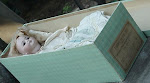
The strangest “memento mori” doll I have is the dried apple doll lying in her own coffin. The doll represents an elderly woman, and she is dressed in white. She lies on white coverings, and has a pillow. Her “coffin” is a leather box with a hinged lid. It is also lined in white material, perhaps muslin. Her eyes are tiny black glass beads, her hair gray. It could be real. The dealer I bought her from told me she had been made many years ago to explain a grandmother’s death to the mourning grandchildren. She is about eleven inches long, coffin and all. She goes well with some shroud scraps I have that came from an Illinois woman’s last fitting, as it were, dated 1898.
Smokey’s Dinosaur: Unlike Killer, my first dog, Smokey, our Benji mix, was indifferent. There were a few he was fond of; he liked dragging around some of the antique dolls but didn’t hurt them, and he liked to chew the shield of one of my nutcrackers when he was teething. Smokey was very fond of two large white Teddy Bears, and I had to move them. He liked to drag them around the house. I finally bought him his own small one. He liked chewing on its nose. I always said, “Smokey, where’s your baby? Don’t chew his nose; you aren’t a good Daddy!” There was one doll Smokey was very fond of. I had a silk-screened T-Rex pillow Smokey liked to sleep on. It was the right height for his little head. Smokey would often be asleep, but when he sensed me coming, he would lift his head, eyes still closed, so I could slip the T-Rex under him. When he died of a stroke at 14, we buried T-Rex with him. It seemed like the right thing to do.
Killer’s Dolls: My first dog, Lord Byron, aka, Killer, was a miniature poodle/Scotty mix. He was very small, with black, curly fur. He hated all dolls and was very jealous. He is the culprit who gnawed Betsey McCall’s foot, and one day, he had my 2 foot Raggedy Ann doll caught in a death grip. He was shaking her by the throat, oblivious to all else going on around him. I often had to rescue tiny dolls from him, and even stuffed dogs, like my giant boxer, were not safe. He had his own squeaky monkey, and slept with some of my stuffed animals when I was very little. I still have him. If FDR could keep Fala’s toys, I can keep Killer’s. One day, my mother and I had come from a doll show. We had done particularly well, and had spread the dolls out on my bed to get a better look. We heard the door creak open; there was Killer. We expected him to jump in the middle of the dolls as he usually did, asserting himself as Alpha dog. Instead, he ran out again, returning with the monkey. This time, he did jump in the middle of the dolls, squeaking the monkey gleefully, as if to say, “see, I have one, too!!”
Violet’s Doll Head: There are some people we meet in life who transcend labels like family, friendship, even soul mate. For me, that person was Violet Ellen Page. Violet was nearly 70 when I met her in 1974, and I was 14. I was at the Aledo, Illinois doll show, a show no longer held. Violet made dolls, and had her own collection of antiques. She liked setting up at the shows, especially with her porcelain dolls and the cloth dolls she adored making. She was super reasonable in her pricing, and very popular with everyone. My special trips when I was a teenager were to her house in Galesburg on Sanborn street. Every nook and cranny held wonderful doll secrets; I spent my allowance on antique dolls, doll parts, clothing, dishes, anything she was willing to sell. She used her earnings to buy ceramics equipment, even a little kiln. Violet even poured her own molds and created her own greenware. She could do everything. She became one of our closest friends, and my dad called her “Yia Yia,” or grandmother, in Greek. She always kept something aside for me of the things she made, always with the story “this mold didn’t pour right, I made too many arms, this dress is a little torn.” “ Would you like this to experiment on?” she would ask. We all knew she wanted to give me something, and I liked giving her small presents, too. Sometimes, when her eyes began to fail, I would embroider doll faces for her and send them to her.
Even when her health failed, we kept visiting her and sending her things. My mother and I would go to Galesburg wherever she had moved, from assisted living to nursing home, and my Dad would often drive us, too. I loved the doll heads and porcelain dolls she made; they all looked like her somehow, with her rosy complexion and flawless skin. Violet used to show me photos of herself when she was very young, and she was beautiful and blonde, with a sweet smile. We were destined to be friends, since her middle name was “Ellen.” She had four boys, so there was really no one to love her dolls. Just me, really. Her other grandchildren, nieces, and daughters in law weren’t that interested in her dolls or antiques.
Violet taught me everything she knew. I learned to put dolls together, to restring them, sew, paint them. She sold and gave me books, scrapbooks, magazines. My best dolls were once hers. I wouldn’t trade anything of hers for the world, and all of them are precious to me, especially the ones she made with her own hands.
She died at nearly 96 in August 2001. It was one of the saddest times in my life. It’s hard to believe even now she is dead. To the end, her mind was sharp and clear. She told poignant stories of life in the nursing home, especially of one old lady with Alzheimer’s who wanted to call her mother to come and get her out of the home. Violet used to say, “you know, one day I’m going to give her a quarter. It might make her feel better.” I used to say Violet was 96 going on 18. Three days after 9/11, about one month after her death, I was at the Stark County Scenic Drive. Visiting the fall scenic drives was a tradition in my family. This year was almost unbearably sad because of Violet’s death and because of 9/11. I was wandering in a park flea market at one of the stops. I walked to the furthest dealer, not really knowing why. He didn’t seem to have any dolls. I’d bought things from him before, but I wasn’t really looking. I saw a faded doll head in his case. He said it was $2.00, so I bought it. The doll head was of a Victorian lady, with molded curls and ornaments in her hair. She had a molded collar, and was very elegant. She was a very good price, but there was something vaguely familiar about her. On the way home, I rode in the backseat of the car. My parents were in front. I took out the head, unwrapped it, and turned in over. Incised on the back, in Violet’s writing, was her last name, “Page.” I had a smaller version of the doll finished at home. Violet had done that one in 1966. I don’t believe in ghosts or portents of any kind, but I still think this was a sign from Violet, a message that she was alright, and that she hadn’t forgotten me, either. I take it as a sign that we really are soul mates, and that no one really dies. Rest in peace. Violet, I will always love you, and your touch will be part of every doll I make.
Mamie Bolin’s Doll Collection: My grade school was Eugene Field School. This was an appropriate name for the school I would eventually attend, because Eugene Field was himself a doll collector. His collection still exists at his home, now a Museum, in St. Louis. Perhaps because of our namesake, my principal at the school, grades K-5, Mamie Bolin, collected dolls. Miss Bolin’s collection was displayed in a special showcase at the front lobby of the school. Even driving by at night, one could see the collection against the shadows in the empty building. Miss Bolin was a sorority sister of my mother’s, and her sister, Mrs. Erma Moser, was my kindergarten teacher. My special treat was to sit in front of the glass cases and look at the fantastic dolls, many from all over the world. There must have been about 500 dolls of all shapes and sizes, many from Holland, Mexico, Spain, the Orient, and other parts of Europe. There was an antique doll in a pink dress with a composition head I was especially fond of; the doll had molded blonde hair, and may have belonged to Miss Bolin’s mother, or grandmother. My piano teacher, Miss Gladys Meurling, also had dolls, but she didn’t give them to me! Instead, she added to Miss Bolin’s collection from time to time.
Dolls were a big part of Eugene Field as it turned out. Ms. Moser had several in the kindergarten room, along with a playhouse complete with tiny pots and pans. I used to play with the larger version of Mary Hartline during recess. One day, Mrs. Moser made me throw away a doll made of crepe paper with a silk painted face. It nearly killed me! But, she was very stern about housecleaning, and I had no choice. Now, I have about 50 of this type of doll in my collection.
My third grade teacher was an awful crank, but she did like dolls, and I often got to take them to show and tell. She took us all on a tour of Miss Bolin’s dolls one day, and promised her a doll from Iran. It was the late sixties, and during the Shah’s era, so Americans could still travel freely.. .
Thursday, April 8, 2010
Mary Ann Cotton Doll?
Good Afternoon,
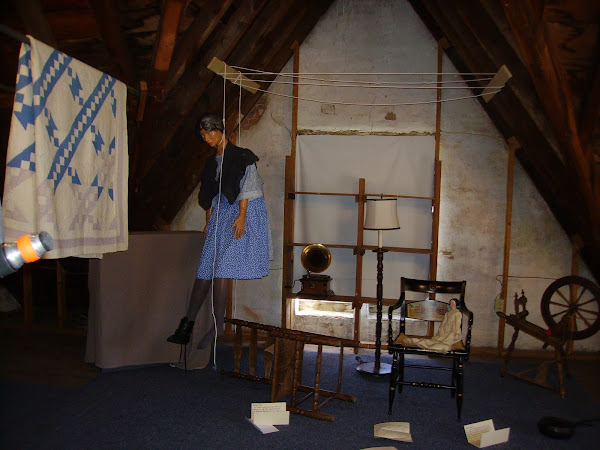
I am full of energy today; it is clear and beautifully sunny. I am asking the help of my readers at this point. About 30 years ago, when Lolly's Doll Museum in Galena was open, I was talking to Lolly's son about a doll called "Hanging Mary," that stood on the gallows, fell through a trap door, and hung as the British National Anthem or funeral march played. I think this may be a doll representing Mary Ann Cotton, who was a poisoner. Does anyone know where I can find a picture of this doll or information about it? Thanks, and have a wonderful day today and always.
Subscribe to:
Posts (Atom)
