


 Posts
Posts



wCWk~%24(KGrHqV,!h8Ew5GsnS3dBMUy3MzVPg~~_3.jpg)

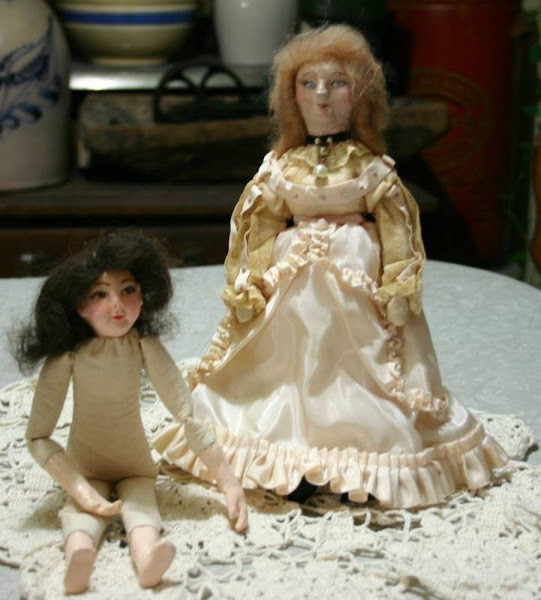








Welcome to spring, finally! I have a few daffodils peeping out in my garden; I don't feel so bad about the neighbors across the street who have whole flower beds blooming already. I have a banged up organge chair I like to keep out with flower pots that is already in its appointed place. I decided to plant orange, red and yellow flowers in different shades to accent it. If my house isn't House Beautiful inside, maybe my yard has a chance. My friend next door and I also like to plant gourds and pumpkins. In part, of course, because the doll creating possibilities are endless. We are going to rotate the soil because we had no luck gettting them to reseed last year. Of course, we had a deer invasion, which didn't help.
Today, I thought I would pick up on another set of books that I have found very useful. These are Pat Smith's guides on various types of dolls, including her hardbound set on modern dolls which first came out in the mid-70s. For those in the doll business, I suspect the books were a godsend; the value of modern dolls went up and up, though online auctions have hurt them in the last year or two. I enjoyed seeing many of the dolls in my collection portrayed, and was inspired to label and organize my dolls. I make a quick and useful inventory of my most used doll books by putting a foil star next to the doll in the guide that is like mine. I write in red pencil the date I bought or acquired the doll. I also try to write the name of the person it came from. If the doll is a reproduction, I put an R by the other data that I've written. It isn't an expert way to keep inventory, but it is a start.
Smith also wrote and compiled books about antique dolls, asian dolls, French and German dolls in particular, and price guides. Two other authors have since consecutively picked up writing the price guides. Pat Smith got a little snappy with me one time on the old AOL Hobby Central; I said something nice about Eleanor St. George's books, and Pat disagreed. Well, in the immortal words of Sly Stone, "different strokes for different folks." I forgive her. Her books are great sources of information.
When I got to Independence, MO as a teenager, I saw some of the dolls in her book displayed. They belonged to people who had contributed to the Modern Doll texts. That was a great trip, except that Kimport Dolls was closed for vacation. Shortly thereafter, Mrs. McKim passed away, and they closed the doll business. Kimport is still alive online and is selling sewing patterns, just as they did when they first went into business.
More tomorrow, but it might be fun to start compiling an informal library and inventory of doll books and sources to use. More about this later.
Till we blog again.
Wednesday, March 31, 2010


Tuesday, March 30, 2010
Toys Soldiers
As promised, below is an excerpt from my book on Metal Dolls. Enjoy!
Chapter 2
Toy Soldiers
In the First World War soldier dolls and tin
soldiers sometimes served in the chauvinistic and militant training of the young. The spirit of war
entered the nursery.
Manfred Bachman
Dolls the Wide World Over
Millions of children throughout the centuries have enjoyed fighting mock battles with toy soldiers. Little boys and girls have long saved their pennies and pocket money to buy small figures of lead and tin with which to people their dreams of heroism nd glory. In fact, the Brontë children's earliest literary endeavors were stories that they wrote about a set of toy soldiers that belonged to Branwell Brontë. Much has been written about the dangers of war toys, including soldiers. Yet, all the criticism does not seem to quell interest in them. One wonders why this is so; recent films including Apocalypse Now, The Killing Fields, Platoon, and Saving Private Ryan have accurately, perhaps too accurately, portrayed the horrors and senselessness of war. In the same light, many novels like Stephen Crane's The Red Badge of Courage and Wilfred Owen's poem "Dulce et Decorum" have also done much to debunk the romanticism of a soldier's life. Yet, children still adore toy soldiers. Some may claim that playing with war toys is cathartic because such play allows children to act out their aggressions in harmless settings, while others may seek to foster courage and patriotism through soldier play. One need only think of Lovelace's famous poem, "To Lucasta on Going to War" and its famous line, "I could not love thee so, dear, loved I not honor more."
At least one teacher I know who is an expert in children's literature has implied that war games, and even violent play, are an innate part of childhood. She has observed that, even if one takes away all toy guns from a little boy, he will chew a peanut butter sandwich into a gun, point it, and shout, "Bang! Bang!" Whatever the reason for their existence, however, toy soldiers, particularly of metal, are here to stay, and are more popular than ever.
The earliest model soldiers were probably made of wood. They represented Prince Ensah's guard and date to the twelfth Egyptian Dynasty, 2000 B.C. Like other dolls, the early toy soldiers were not meant to be toys. Rather, they accompanied their deceased owners to the underworld. One historian has said that model solders were not really popular in the Ancient world, (Alberini 5), but he then cites a Roman legionary made of tin from the Imperial Epoch (6). Also, a fifteen inch bronze model of an equestrian survives from ancient Greece. Flat lead soldiers existed in Rome in the third century A.D. The most famous model soldiers of recent times are probably the life-sized army of Chinese figures which numbered in the thousands and once adorned an emperor's tomb. These are currently reproduced as clay miniatures and may be purchased in many import and specialty stores.
As toys, model soldiers first appeared in the Middle Ages (Fawcett 215). Of these, Leslie Gordon has said that "[e]xcept for the ancient 'magic' doll, it is possible that the toy soldier, who made his first appearance in Europe in Medieval times, was the first doll to be made of metal" (43). Some of these soldiers may have had model accessories and buildings. For example, there is a four inch wooden model of the Bloody Tower of the Tower of London which may have belonged to the Little Princes murdered there. One author speculates that this model had little figures, perhaps made of metal, to go with it (Garrat 12). Such a concept is not hard to envision; even ancient dolls had tiny dishes and other accessories with them, and companies like Playskool and Lego, manufacturers of educational playthings, make toy castles complete with knights and guards.
Interest in toys that teach is not unique to our century. In the fifteenth century, historical model soldiers first appeared. Marie d' Medici is supposed to have had silver toy soldiers made for her son, Louis XIII (Alberini). As an adult, Louis supposedly melted them down to fund his wars (6). Bronze-cast tournament toys existed as early as 1490 and the Kunst Historiches Museum in Vienna has several examples. Also, the toy museum in Salzburg has a large collection of toy soldiers and model figures. One group represents five members of the ski patrol. They are complete to their clubs, rifles and ski poles.
Another group from the Salzburg Museum represents an open carriage with two, well-dressed passengers. The driver and his groom wear plumed helmets and the horse are white. The entire piece is well- painted and appears to be beautifully preserved. Still another interesting arrangement represents a group of jockeys. Part of the display includes dice, coins, and other paraphernalia of gambling. In the background is a flier explaining the steeple chase.
Some of these early soldiers and models were breathtaking in detail. One incredibly intricate lead musketeer is French and dates from about the time of Henry IV. It stands three inches (Garrat 13). At Cluny are two Medieval knights made of tin. Some of the Cluny soldiers were worked in gold and silver decorated with enameled bronze (Harris 8). A similar ship with soldiers in the Victoria and Albert Museum is German in origin. One of these ships represents Charles V and his court moving on deck (8).
By the early sixteenth century, some model and toy soldiers were on rollers and held miniature lances. The eighteenth century discovery of alloys facilitated the manufacture of toy soldiers (Alberini 7). Now, other metals could be mixed with the inexpensive tin to make a variety of goods. Standardized uniforms also came into use. As a result, the figures could be mass produced. Early boxed sets were sold unpainted by military unit in wooden boxes. They came in weights of 1 lb, 1/2 lb and 1/8 lb. Each kit contained from twenty to 150 soldiers (7). It is difficult to determine which manufacturer made these early soldiers because they were made before registration laws existed. Some manufacturers, however, marked their figures with initials (White 58).
Apparently, Frederick the Great inspired the creation of model soldiers in England (Hillier APOT 70). One early version was a "flat soldier," 30 mm in height (70). This height became standard for one maker, Henrichsen of Nuremburg, and was gradually adopted by others (70). Heinrichsen's sets included well-written histories to educate children (70). . .
Chapter 2
Toy Soldiers
In the First World War soldier dolls and tin
soldiers sometimes served in the chauvinistic and militant training of the young. The spirit of war
entered the nursery.
Manfred Bachman
Dolls the Wide World Over
Millions of children throughout the centuries have enjoyed fighting mock battles with toy soldiers. Little boys and girls have long saved their pennies and pocket money to buy small figures of lead and tin with which to people their dreams of heroism nd glory. In fact, the Brontë children's earliest literary endeavors were stories that they wrote about a set of toy soldiers that belonged to Branwell Brontë. Much has been written about the dangers of war toys, including soldiers. Yet, all the criticism does not seem to quell interest in them. One wonders why this is so; recent films including Apocalypse Now, The Killing Fields, Platoon, and Saving Private Ryan have accurately, perhaps too accurately, portrayed the horrors and senselessness of war. In the same light, many novels like Stephen Crane's The Red Badge of Courage and Wilfred Owen's poem "Dulce et Decorum" have also done much to debunk the romanticism of a soldier's life. Yet, children still adore toy soldiers. Some may claim that playing with war toys is cathartic because such play allows children to act out their aggressions in harmless settings, while others may seek to foster courage and patriotism through soldier play. One need only think of Lovelace's famous poem, "To Lucasta on Going to War" and its famous line, "I could not love thee so, dear, loved I not honor more."
At least one teacher I know who is an expert in children's literature has implied that war games, and even violent play, are an innate part of childhood. She has observed that, even if one takes away all toy guns from a little boy, he will chew a peanut butter sandwich into a gun, point it, and shout, "Bang! Bang!" Whatever the reason for their existence, however, toy soldiers, particularly of metal, are here to stay, and are more popular than ever.
The earliest model soldiers were probably made of wood. They represented Prince Ensah's guard and date to the twelfth Egyptian Dynasty, 2000 B.C. Like other dolls, the early toy soldiers were not meant to be toys. Rather, they accompanied their deceased owners to the underworld. One historian has said that model solders were not really popular in the Ancient world, (Alberini 5), but he then cites a Roman legionary made of tin from the Imperial Epoch (6). Also, a fifteen inch bronze model of an equestrian survives from ancient Greece. Flat lead soldiers existed in Rome in the third century A.D. The most famous model soldiers of recent times are probably the life-sized army of Chinese figures which numbered in the thousands and once adorned an emperor's tomb. These are currently reproduced as clay miniatures and may be purchased in many import and specialty stores.
As toys, model soldiers first appeared in the Middle Ages (Fawcett 215). Of these, Leslie Gordon has said that "[e]xcept for the ancient 'magic' doll, it is possible that the toy soldier, who made his first appearance in Europe in Medieval times, was the first doll to be made of metal" (43). Some of these soldiers may have had model accessories and buildings. For example, there is a four inch wooden model of the Bloody Tower of the Tower of London which may have belonged to the Little Princes murdered there. One author speculates that this model had little figures, perhaps made of metal, to go with it (Garrat 12). Such a concept is not hard to envision; even ancient dolls had tiny dishes and other accessories with them, and companies like Playskool and Lego, manufacturers of educational playthings, make toy castles complete with knights and guards.
Interest in toys that teach is not unique to our century. In the fifteenth century, historical model soldiers first appeared. Marie d' Medici is supposed to have had silver toy soldiers made for her son, Louis XIII (Alberini). As an adult, Louis supposedly melted them down to fund his wars (6). Bronze-cast tournament toys existed as early as 1490 and the Kunst Historiches Museum in Vienna has several examples. Also, the toy museum in Salzburg has a large collection of toy soldiers and model figures. One group represents five members of the ski patrol. They are complete to their clubs, rifles and ski poles.
Another group from the Salzburg Museum represents an open carriage with two, well-dressed passengers. The driver and his groom wear plumed helmets and the horse are white. The entire piece is well- painted and appears to be beautifully preserved. Still another interesting arrangement represents a group of jockeys. Part of the display includes dice, coins, and other paraphernalia of gambling. In the background is a flier explaining the steeple chase.
Some of these early soldiers and models were breathtaking in detail. One incredibly intricate lead musketeer is French and dates from about the time of Henry IV. It stands three inches (Garrat 13). At Cluny are two Medieval knights made of tin. Some of the Cluny soldiers were worked in gold and silver decorated with enameled bronze (Harris 8). A similar ship with soldiers in the Victoria and Albert Museum is German in origin. One of these ships represents Charles V and his court moving on deck (8).
By the early sixteenth century, some model and toy soldiers were on rollers and held miniature lances. The eighteenth century discovery of alloys facilitated the manufacture of toy soldiers (Alberini 7). Now, other metals could be mixed with the inexpensive tin to make a variety of goods. Standardized uniforms also came into use. As a result, the figures could be mass produced. Early boxed sets were sold unpainted by military unit in wooden boxes. They came in weights of 1 lb, 1/2 lb and 1/8 lb. Each kit contained from twenty to 150 soldiers (7). It is difficult to determine which manufacturer made these early soldiers because they were made before registration laws existed. Some manufacturers, however, marked their figures with initials (White 58).
Apparently, Frederick the Great inspired the creation of model soldiers in England (Hillier APOT 70). One early version was a "flat soldier," 30 mm in height (70). This height became standard for one maker, Henrichsen of Nuremburg, and was gradually adopted by others (70). Heinrichsen's sets included well-written histories to educate children (70). . .
Action Figures, Boy Dolls, and Manly Men
When I can get to a computer with an A drive, I'll download some excerpts from my book on metal dolls that deal with toy soldiers. We don't seem to have anything like that around here that's handy. Meanwhile, I want to just touch on the idea of men and dolls. I firmly believe that toy soldiers, robots, and action figures belong under the title, "Doll." I've caused many traumas with this view; one of my male students at my old school insisted G.I. Joe could never be a doll, until I showed him the chapter in The Ultimate Doll Book devoted to that brave lad. Why should it be an insult? Long before William's Doll was written, there was The Velvateen Rabbit, and Johl's chapters on boy dolls and dolls owned by boys and men. Eugene Field had his collection, discussed before on this blog. John Wayne, Senator Barry Goldwater, and my favorite law professor collected Kachina Dolls, and it was men who wrote the first important texts on these types of dolls, whether they are that accurate or not by today's standards. Peter the Great liked them, and many famous men owned or created automatons including Charlemagne. There were dolls, Ushabti, and toys in Tut's Tomb [love how that sounds!], and Samuel Pryor amassed a fantastic collection. Malcolm Forbes and Rod Stewart are known for their toy soldier collections, and the great Freud collected ancient figurines, dolls, and shulptures. And, let's not forget our authors, John Noble, Carl Fox, and Max von Boehn. My little boy had his share of action figures and robots; when he saw my display of German Dolls at a local cultural center, he was only two, but blurted out as he stared into the glass entranced, "Can we take them out!?" My baby boy cousin loved stuffed animals, and had a couple of my baby dolls to play with [when he grew up, I reclaimed them]. Other brothers and friends had their soldiers and Major Matt Masons, their Big Jims and Stretch Armstrongs. And, of course, there is Teddy, in all his manifestations and with all his famous owners, real and fictional, from Prince Charles, Peter Bull, and Thurston Howell III to Radar O'Riley. Well, why not?
I love "boy dolls." All types of them, from Santa Clauses, to scary vampires, to Ken and G.I. Joe and their wonderful knockoffs, to my lead soldiers and plastic soldiers, my Mego action figures, my antique parian and china men. You name it. I have hand carved Zulu warriors, the afore mentioned Little Drummer Boy, my bears and Sponge Bobs, my Southpark Figures, my McFarlane action figures, the most fantastic of all action figures, my robtos and my Star Wars and other intergalactic family members. They all have a place in the collection and upcoming museum. Even my daintier female students love my little Jack the Ripper and Attilla the Hun McFarlane figures, and everyone loves my Teddy Bears and Gollies. Fonzie, who could flip his thumbs, was a huge favorite with my second graders in the 80s, and my little Crypt Keeper and Mechanical "Frankie" are huge hits at Halloween. One of the men who lives next door, husband of a friend of mine, asks for my screaming vampire Count Dracula every Halloween. I hang him outside the door, but only when I'm there to guard him, and he flies, flashes red eyes, and screams Banshee-like greetings to all the little kids who Trick or Treat. They adore him, too. Let's not forget the May 5th Boy's Festival in Japan, either. I would love to be there, and to add more Samurai, maybe a Bunraku or another Karakuri to my collection!
So, enjoy the coming article on Toy Soldiers. That excerpt used to get me interviews in law firms where legal documents didn't, maybe because I proved I could publish something, or maybe because the hiring attorneys loved toy soldiers and toys, too. And men, remember and be proud, whether you call them action figures, soldiers, effigies, or figurines, a doll by any other name is still a doll, or to paraphrase Dr. Stein, who is herself immortalized in several doll forms, "A doll is a doll, is a doll, is a doll!" Till next time, keep in mind, I never met a doll I didn't like.
I love "boy dolls." All types of them, from Santa Clauses, to scary vampires, to Ken and G.I. Joe and their wonderful knockoffs, to my lead soldiers and plastic soldiers, my Mego action figures, my antique parian and china men. You name it. I have hand carved Zulu warriors, the afore mentioned Little Drummer Boy, my bears and Sponge Bobs, my Southpark Figures, my McFarlane action figures, the most fantastic of all action figures, my robtos and my Star Wars and other intergalactic family members. They all have a place in the collection and upcoming museum. Even my daintier female students love my little Jack the Ripper and Attilla the Hun McFarlane figures, and everyone loves my Teddy Bears and Gollies. Fonzie, who could flip his thumbs, was a huge favorite with my second graders in the 80s, and my little Crypt Keeper and Mechanical "Frankie" are huge hits at Halloween. One of the men who lives next door, husband of a friend of mine, asks for my screaming vampire Count Dracula every Halloween. I hang him outside the door, but only when I'm there to guard him, and he flies, flashes red eyes, and screams Banshee-like greetings to all the little kids who Trick or Treat. They adore him, too. Let's not forget the May 5th Boy's Festival in Japan, either. I would love to be there, and to add more Samurai, maybe a Bunraku or another Karakuri to my collection!
So, enjoy the coming article on Toy Soldiers. That excerpt used to get me interviews in law firms where legal documents didn't, maybe because I proved I could publish something, or maybe because the hiring attorneys loved toy soldiers and toys, too. And men, remember and be proud, whether you call them action figures, soldiers, effigies, or figurines, a doll by any other name is still a doll, or to paraphrase Dr. Stein, who is herself immortalized in several doll forms, "A doll is a doll, is a doll, is a doll!" Till next time, keep in mind, I never met a doll I didn't like.
Monday, March 29, 2010
Favorite Dolls
Good morning on a beautiful Midwest Monday. Easter is Sunday, and this year Eastern Orthodox Easter and what we call Protestant Easter are the same Sunday. This is good, too, but we lose out on Easter sales when they are the same day. I thought I would describe a few of my favorite dolls. I'd like to limit and say two, three, or four favorites, but that is nearly impossible. The older I get, the more challenged I am at counting, though I can figure percentages in my head.
1. Vogue's 1964 Baby Dear. She is about the size of a newborn. Her name is Candy, don't ask why, and I got her when I was five. In those days [September 1965], our big local department store began displaying Christmas dolls early. There was no Toys R Us or Walmart [it was really the Dark Ages!], and the department stores had amazing things. I remember getting hard plastic Nancy Anns in boxes, beautiful Vogue, Effanbee, and Madame Alexanders, every type of Barbie available, Tammy and Ideal dolls, Horsman, silk and stockinette Bradley ladies with outfits to die for, even some nice Shackman bisques and Sasha dolls. My parents took me to look at the dolls to choose the one I liked for Christmas. I got so emotionally swept up that Candy came home in September. She has never left. She has had many "surgeries" to refurbish her stuffing, and there is a crayon heart drawn on her chest. She has several wardrobes and warm blankets; when I was six or seven, I was admonished by a lady working in one of the stores we frequented for not dressing my "baby" in warmer clothes on a cold February day. Candy has been to graduate school, has crossed country several times, and will always be with me. I have several other versions of this doll in many sizes, skin tones, with wigs, from other manufacturers. I found severl Eloise Wilkin books go go with her. She is an endearing doll, and even Krutschev liked her. After he finished banging his shoe on the table at the UN, he bought several dolls like Candy to take home as gifts. Go figure.
2. Mousie. He is a stuffed animal, about 11 inches. He is a little gray mouse wearing a pink and white lace collar. His tale is a long piece of elastic with a little bell attached. He is Candy's faithful companion and has been since I got him for my seventh birthday. He appears in the birthday picture taken of me that year.
3. The Little Drummer Boy. He isn't really a doll, but an approximately 12.5" sculpture from the Sudan. He is playing a drum. He belonged to my Uncle George, who was only a few years older than I. He was the big brother I never had, and since he was the baby of his family, I think he enjoyed the role. I took TLDB everywhere, often without exactly getting express permission. Somewhere along the line, he injured a foot. My Uncle Tom, who was an artist, repaired it. In fact, Uncle Tom learned doll hospital work through practial experience and had many patients. When my mothers' family moved out west, George left The Little Drummer Boy with me. There is a photo of me holding the little statue, and wearing my Uncle George's mortar board from I thinkg high school. In college, he used to take me with him everyhwere, and read to me from history books about Elizabeth I. I was even invited on dates with him from time to time and hte taught me to love Peter, Paul and Mary and Petula Clark. Those were really more innocent days!
4. Joanna. She is a 3" Shackman reproduction parian. Her hair is blonde, her limbs porcelain. She wears a black band in her pulled back hair. Her full name is Joanna Plantaganet, per the family given my doll house dolls. Her dress is tiny black and white stripes with leg o'mutton sleeves. She appeared in my Christmas stocking when I was ten. I have obtained sisters for her since then wearing red stripes, also from Shackman, but they are not as dainty as Joanna.
5. Charlotte; you guessed it; she is a 2" or so Frozen Charlotte with arms outstretched. She has a tiny foot injury from too much love, but then I broke my foot, too, years ago. Art imitates life. She was my first antique doll; we bought her for the huge sum of $5.00 at the Women's Club Antique show when I was seven. That was my first antique show. My poor mother hated old things, but she adored me, and the dolls, so, off we used to go. My dad would drive, but usually stayed in the car reading Newsweek. I've been going to Antique Shows ever since, and as one dealer said to me, "You grew up with us."
6. Suzanne Gibson. She is one of the little porcelain girls made for Knotts Berry Farm. At the time, she was expensive, and I was surprised my Dad bought her. As he says, his hand still hurts from writing the check. Suzanne Gibson later became a friend and a penpal, and she emailed me a photo of one of my doll's sisters. These were my first introduction to porcelain dolls and to N.I.A.D.A dolls and I was entranced. That was a great trip; I was ten, and first saw Mott's Miniature Museum, then housed in Knotts. My mom found all kinds of miniature dolls and Shackman dolls on her rounds of the toys stores and gift shops. We still have and love all these dolls, including the wooden bodied mannikin dolls with the Goeble half-doll head and long blonde curls. Suzanne's doll is really one of my all time favorites.
7. 9.5" Barrois Fashion; she has a small hairline, but great provenance. I bought her from Jim Fernando and his business partner. They even found a French bag to put her in. I went running to the bank for the money when I saw her, and they turned her face around on the table. Still, everyone wanted to buy her in my absence! I've collected all sorts of little things for her over the years, but she needs a pair of original shoes to fit her. she is fragile, and doesn't travel to lectures anymore. Everyone who does see her loves her. I never thought I would have a real French Fashion, and got very excited with this one.
8. My "misfit" or distressed dolls. These are the odds and ends I made over the years. They live in a cardboard box, but are occasionally taken out, refurbished, and displayed. Many are "wax" dolls made from melted candles, others are Play Dough and clay varnished to last. I even have a couple versions of Joan of Arc, one dressed in tin foil armour, and dozens and dozens of paper dolls. My friends often contributed to the Misfits. One of them made me a doll from two pieces of a ruler. That "little girl" now lives two doors down, and I live in a house her sister once lived in. Serendipity.
9. My "angels and demons." I love Halloween, Christmas, all holidays and their decorations. I have some gruesome dolls and litte monsters as a result. My mother used to like to dress them, so that our Alien queen wears a tasteful red knitted sunddresss, and the two-heade demon baby wears a layette, hand crocheted. My skeletons all have lovely outfits, and the largest, Ophelia, has seasonal sweaters to wear over her bride's dress. Shs sings "White Wedding" and talks. She is about the size of a three year old. At first, little kids are a little afraid of her, but then they make friends. I also love my plush bunnies, treetop angels, carolers, and leprechauns. Even the doll houses get decorated, sometimes all at once.
I think that's enough favorites for now. I may add some nostalgia in future blogs and talk about sixties/seventies doll shopping, as well as some of the dolls that got away. Happy Dolling, Happy Easter, and a Blessed Passover as well.
1. Vogue's 1964 Baby Dear. She is about the size of a newborn. Her name is Candy, don't ask why, and I got her when I was five. In those days [September 1965], our big local department store began displaying Christmas dolls early. There was no Toys R Us or Walmart [it was really the Dark Ages!], and the department stores had amazing things. I remember getting hard plastic Nancy Anns in boxes, beautiful Vogue, Effanbee, and Madame Alexanders, every type of Barbie available, Tammy and Ideal dolls, Horsman, silk and stockinette Bradley ladies with outfits to die for, even some nice Shackman bisques and Sasha dolls. My parents took me to look at the dolls to choose the one I liked for Christmas. I got so emotionally swept up that Candy came home in September. She has never left. She has had many "surgeries" to refurbish her stuffing, and there is a crayon heart drawn on her chest. She has several wardrobes and warm blankets; when I was six or seven, I was admonished by a lady working in one of the stores we frequented for not dressing my "baby" in warmer clothes on a cold February day. Candy has been to graduate school, has crossed country several times, and will always be with me. I have several other versions of this doll in many sizes, skin tones, with wigs, from other manufacturers. I found severl Eloise Wilkin books go go with her. She is an endearing doll, and even Krutschev liked her. After he finished banging his shoe on the table at the UN, he bought several dolls like Candy to take home as gifts. Go figure.
2. Mousie. He is a stuffed animal, about 11 inches. He is a little gray mouse wearing a pink and white lace collar. His tale is a long piece of elastic with a little bell attached. He is Candy's faithful companion and has been since I got him for my seventh birthday. He appears in the birthday picture taken of me that year.
3. The Little Drummer Boy. He isn't really a doll, but an approximately 12.5" sculpture from the Sudan. He is playing a drum. He belonged to my Uncle George, who was only a few years older than I. He was the big brother I never had, and since he was the baby of his family, I think he enjoyed the role. I took TLDB everywhere, often without exactly getting express permission. Somewhere along the line, he injured a foot. My Uncle Tom, who was an artist, repaired it. In fact, Uncle Tom learned doll hospital work through practial experience and had many patients. When my mothers' family moved out west, George left The Little Drummer Boy with me. There is a photo of me holding the little statue, and wearing my Uncle George's mortar board from I thinkg high school. In college, he used to take me with him everyhwere, and read to me from history books about Elizabeth I. I was even invited on dates with him from time to time and hte taught me to love Peter, Paul and Mary and Petula Clark. Those were really more innocent days!
4. Joanna. She is a 3" Shackman reproduction parian. Her hair is blonde, her limbs porcelain. She wears a black band in her pulled back hair. Her full name is Joanna Plantaganet, per the family given my doll house dolls. Her dress is tiny black and white stripes with leg o'mutton sleeves. She appeared in my Christmas stocking when I was ten. I have obtained sisters for her since then wearing red stripes, also from Shackman, but they are not as dainty as Joanna.
5. Charlotte; you guessed it; she is a 2" or so Frozen Charlotte with arms outstretched. She has a tiny foot injury from too much love, but then I broke my foot, too, years ago. Art imitates life. She was my first antique doll; we bought her for the huge sum of $5.00 at the Women's Club Antique show when I was seven. That was my first antique show. My poor mother hated old things, but she adored me, and the dolls, so, off we used to go. My dad would drive, but usually stayed in the car reading Newsweek. I've been going to Antique Shows ever since, and as one dealer said to me, "You grew up with us."
6. Suzanne Gibson. She is one of the little porcelain girls made for Knotts Berry Farm. At the time, she was expensive, and I was surprised my Dad bought her. As he says, his hand still hurts from writing the check. Suzanne Gibson later became a friend and a penpal, and she emailed me a photo of one of my doll's sisters. These were my first introduction to porcelain dolls and to N.I.A.D.A dolls and I was entranced. That was a great trip; I was ten, and first saw Mott's Miniature Museum, then housed in Knotts. My mom found all kinds of miniature dolls and Shackman dolls on her rounds of the toys stores and gift shops. We still have and love all these dolls, including the wooden bodied mannikin dolls with the Goeble half-doll head and long blonde curls. Suzanne's doll is really one of my all time favorites.
7. 9.5" Barrois Fashion; she has a small hairline, but great provenance. I bought her from Jim Fernando and his business partner. They even found a French bag to put her in. I went running to the bank for the money when I saw her, and they turned her face around on the table. Still, everyone wanted to buy her in my absence! I've collected all sorts of little things for her over the years, but she needs a pair of original shoes to fit her. she is fragile, and doesn't travel to lectures anymore. Everyone who does see her loves her. I never thought I would have a real French Fashion, and got very excited with this one.
8. My "misfit" or distressed dolls. These are the odds and ends I made over the years. They live in a cardboard box, but are occasionally taken out, refurbished, and displayed. Many are "wax" dolls made from melted candles, others are Play Dough and clay varnished to last. I even have a couple versions of Joan of Arc, one dressed in tin foil armour, and dozens and dozens of paper dolls. My friends often contributed to the Misfits. One of them made me a doll from two pieces of a ruler. That "little girl" now lives two doors down, and I live in a house her sister once lived in. Serendipity.
9. My "angels and demons." I love Halloween, Christmas, all holidays and their decorations. I have some gruesome dolls and litte monsters as a result. My mother used to like to dress them, so that our Alien queen wears a tasteful red knitted sunddresss, and the two-heade demon baby wears a layette, hand crocheted. My skeletons all have lovely outfits, and the largest, Ophelia, has seasonal sweaters to wear over her bride's dress. Shs sings "White Wedding" and talks. She is about the size of a three year old. At first, little kids are a little afraid of her, but then they make friends. I also love my plush bunnies, treetop angels, carolers, and leprechauns. Even the doll houses get decorated, sometimes all at once.
I think that's enough favorites for now. I may add some nostalgia in future blogs and talk about sixties/seventies doll shopping, as well as some of the dolls that got away. Happy Dolling, Happy Easter, and a Blessed Passover as well.
Sunday, March 28, 2010
The Art of Blogging!
Slowly, but surely, I am seeing and learning how the blogging community works. Thanks to new followers, and welcome, and thanks for the kind comments and to all who have emailed. It is encouraging to hear from so many good writers and from people who are interested in dolls. Hardly anyone really knows about my collection any more, and in some ways, this can be a good thing. On the other hand, you feel a little bit out in the wilderness, and despite the popularity of this hobby, you still get funny looks at yard sales and the occasional antique show. C'est la guerre. Then again, I used to teach a class on dolls for CommUniversity, a local group of higher education organziations and colleges that teaches classes Sundays in February [www.communiversity.org]. When people came to my class, I was really surprised at the depth and interest in the subject.
Today I began organizing dolls and materials for the Girl Scouts program where we are going to make a Victorian fortune teller paper doll, and learn about the history of dolls. Little kids are great audiences; they are ready to share their own stories and inspire me as much as I hope I inspire them. With that in mind, I'd like to mention a couple books out there for kids that talk about collecting, and that they will enjoy and find fun.
1. Shari Lewis. Things Kids Collect. This is a slim paperback with chapters on doll collecting, coins, stamps, souvenirs, rocks, shells, etc. Almost anything a child might like is included. Of course, Shari Lewis is Lambchop's "mother." I was still watching Lambchop in graduate school at SIUC in the early and mid 90s. Shortly after, Shari Lewis died at a fairly young age. She had her own fantastic collection of dolls and puppets, and I don't know whatever happened to them.
2. Shirley Glubok's books about dolls and doll collecting for children are great. They cover all types of enthnic and antique dolls and also talk about how dolls relate to culture and history.
3. Tasha Tudor. A is for Annabelle and The Doll's Christmas. Tudor had her own fantastic dolls and doll house. She illustrated these two books with French Fashion dolls and old china heads and papier mache little girls. They are just great! About 20 years ago, I wrote Tudor a letter, and she answered me and drew a sketch of the dolls in The Doll's Christmas. I nearly melted with excitement.
4. Rumer Godden. Miss Happiness and Miss Flower, Home is the Sailor, Little Plum, Holly and Ivy, and The Doll's House. In honor of the latter, I named my main dollhouse family Plantaganet. Mr. and Mrs. Plantaganet were in two versions, a pair of East German rubber dolls, man and woman, in Dutch costume, or, an 8" Effanbee little boy baby doll in a red flannel suit and an 8" late composition late 40s Mexican doll with her mohair wig done up in braids on top of her head. [The N.A.M.E folks would hate me; I don't find scale all that thrilling. I like effect better in miniatures and doll houses]. Various other dolls made up the rest of the staff and family of Plantaganet house, including some homemade, rather pathetic examples I used to create. The dolls had lots of visitors, and even had stores and businesses, as well as a diary that chronicled the family history. The drama in the Tasha Tudor illustrated book is anything but childlike, but good certainly triumphs. Miss Happiness and Miss Flower and Little Plum are stories about ex patriated Japanese Dolls, and I loved reading them over and over. From them, I learned about the March 3d Japanese Doll Festival, and have tried to honor it and build Japanese doll houses ever since. Home is the Sailor is about several generations of a Victorian doll house that are much loved, and that have their own life dramas. The rest of my dolls were named Poppy and Miss Charlotte after that family. Any child would still be inspired by Godden's stories. I wrote to her in graduate school about her adult novels. She wrote a very long helpful letter, apologizing for answering late. She was in her late 80s at the time, and had just returned from Greece. She was another very talented and inspiring lady. Holly and Ivy has been made into a cartoon called, I think The Christmas Wish, and is a story about a lonely doll and a lonely little girl who find each other and become happy.
5. The Raggedy Ann Stories by Johnny Gruelle and other authors and illustrators. I never got enough of these stories, and loved acting them out with my own Anns and Andys. My third grade teacher liked dolls and used to read them to us. I began to believe there were candy cotton clouds and chocolate mud puddles, not to mention cookie trees. I also loved my Raggedy Ann coloring books which told stories as well, and my paper dolls and cards. My original Raggedy is one of my four all time favorite dolls that I would never part with. Then, what is it we say, they're all our favorites!
6. Another great story for kids is Floating Island by Anne Parrish, about a doll house family marooned on an island. It is a happy and exciting story of survival, sort of a Swiss Family Robinson for toys.
7. Missing Melinda, by Jacqueline Jackson. This is a great mystery story, first discovered in my grade school library, appropriately, Eugene Field School. Field, as we know, was another famous doll collector. Two sisters named for Shakespeare's Cordelia and Ophelia by their professor father must solve the mystery of a stolen Parian doll named Melinda, which they find in their attic but which is later stolen. They explore antique shops, thrift stores, and collector's houses, and meet the owner of a doll hospital who must have had Emma Clear as her prototype. I've read it over and over again, and never get tired of the endless array of dolls discussed. This was one of my first introductions to Shakespeare, as well, which was a good thing since I later taught him and wrote about him. I think the two sisters got me thinking.
These are wonderful stories, but they also get children interested in collecting. The Boy Scouts sell a very nice brochure about their own collecting badge, and there are other books including Miss Hickory, Hitty, The Doll People, The Little Wooden Doll, The Edith the Lonely Doll books, stories in the Little House Series, Jane Eyre, Miss Flora McFlimsey, and other stories about dolls and toys that kids would really enjoy. Amazon. com is great place to find them, as is Alibris. Happy Reading! Till we blog again.
Today I began organizing dolls and materials for the Girl Scouts program where we are going to make a Victorian fortune teller paper doll, and learn about the history of dolls. Little kids are great audiences; they are ready to share their own stories and inspire me as much as I hope I inspire them. With that in mind, I'd like to mention a couple books out there for kids that talk about collecting, and that they will enjoy and find fun.
1. Shari Lewis. Things Kids Collect. This is a slim paperback with chapters on doll collecting, coins, stamps, souvenirs, rocks, shells, etc. Almost anything a child might like is included. Of course, Shari Lewis is Lambchop's "mother." I was still watching Lambchop in graduate school at SIUC in the early and mid 90s. Shortly after, Shari Lewis died at a fairly young age. She had her own fantastic collection of dolls and puppets, and I don't know whatever happened to them.
2. Shirley Glubok's books about dolls and doll collecting for children are great. They cover all types of enthnic and antique dolls and also talk about how dolls relate to culture and history.
3. Tasha Tudor. A is for Annabelle and The Doll's Christmas. Tudor had her own fantastic dolls and doll house. She illustrated these two books with French Fashion dolls and old china heads and papier mache little girls. They are just great! About 20 years ago, I wrote Tudor a letter, and she answered me and drew a sketch of the dolls in The Doll's Christmas. I nearly melted with excitement.
4. Rumer Godden. Miss Happiness and Miss Flower, Home is the Sailor, Little Plum, Holly and Ivy, and The Doll's House. In honor of the latter, I named my main dollhouse family Plantaganet. Mr. and Mrs. Plantaganet were in two versions, a pair of East German rubber dolls, man and woman, in Dutch costume, or, an 8" Effanbee little boy baby doll in a red flannel suit and an 8" late composition late 40s Mexican doll with her mohair wig done up in braids on top of her head. [The N.A.M.E folks would hate me; I don't find scale all that thrilling. I like effect better in miniatures and doll houses]. Various other dolls made up the rest of the staff and family of Plantaganet house, including some homemade, rather pathetic examples I used to create. The dolls had lots of visitors, and even had stores and businesses, as well as a diary that chronicled the family history. The drama in the Tasha Tudor illustrated book is anything but childlike, but good certainly triumphs. Miss Happiness and Miss Flower and Little Plum are stories about ex patriated Japanese Dolls, and I loved reading them over and over. From them, I learned about the March 3d Japanese Doll Festival, and have tried to honor it and build Japanese doll houses ever since. Home is the Sailor is about several generations of a Victorian doll house that are much loved, and that have their own life dramas. The rest of my dolls were named Poppy and Miss Charlotte after that family. Any child would still be inspired by Godden's stories. I wrote to her in graduate school about her adult novels. She wrote a very long helpful letter, apologizing for answering late. She was in her late 80s at the time, and had just returned from Greece. She was another very talented and inspiring lady. Holly and Ivy has been made into a cartoon called, I think The Christmas Wish, and is a story about a lonely doll and a lonely little girl who find each other and become happy.
5. The Raggedy Ann Stories by Johnny Gruelle and other authors and illustrators. I never got enough of these stories, and loved acting them out with my own Anns and Andys. My third grade teacher liked dolls and used to read them to us. I began to believe there were candy cotton clouds and chocolate mud puddles, not to mention cookie trees. I also loved my Raggedy Ann coloring books which told stories as well, and my paper dolls and cards. My original Raggedy is one of my four all time favorite dolls that I would never part with. Then, what is it we say, they're all our favorites!
6. Another great story for kids is Floating Island by Anne Parrish, about a doll house family marooned on an island. It is a happy and exciting story of survival, sort of a Swiss Family Robinson for toys.
7. Missing Melinda, by Jacqueline Jackson. This is a great mystery story, first discovered in my grade school library, appropriately, Eugene Field School. Field, as we know, was another famous doll collector. Two sisters named for Shakespeare's Cordelia and Ophelia by their professor father must solve the mystery of a stolen Parian doll named Melinda, which they find in their attic but which is later stolen. They explore antique shops, thrift stores, and collector's houses, and meet the owner of a doll hospital who must have had Emma Clear as her prototype. I've read it over and over again, and never get tired of the endless array of dolls discussed. This was one of my first introductions to Shakespeare, as well, which was a good thing since I later taught him and wrote about him. I think the two sisters got me thinking.
These are wonderful stories, but they also get children interested in collecting. The Boy Scouts sell a very nice brochure about their own collecting badge, and there are other books including Miss Hickory, Hitty, The Doll People, The Little Wooden Doll, The Edith the Lonely Doll books, stories in the Little House Series, Jane Eyre, Miss Flora McFlimsey, and other stories about dolls and toys that kids would really enjoy. Amazon. com is great place to find them, as is Alibris. Happy Reading! Till we blog again.
Saturday, March 27, 2010
14 for Good Luck!
A quick greeting-I noticed I had 13 posts, and then had an awful time adding a photo. Thanks to the kind people from Dover for their free clip art edition. Hopefully, I can add more photos of my dolls.
Metal Heads and Musings
Today's blog is an excerpt from my book on Metal Dolls. I hope you enjoy it. I am still looking for clear photographs for this book, and you can email me at etsag1998@aol.com with photos and questions. eBay photos work nicely and are easy to mail. Also, include how you would like to be credited. Two sites I recommend for doll and toy enthusiasts are The Official Louvre Website and the Musee de la Poupee. There are links and activities for children and adults, and excellent displays in both on dolls. Each has a museum store, of course. The Louvre is easy to search; I put in the word "doll" and found all kinds of beautiful examples of painting and art but also example of Ancient Greek and Roman dolls, some articulated. It is easy to print and download these photos, and The Louvre is generous with printing and dowloading rights. The first time I saw these ancient playthings in the National Museum in Athens, and I cried. I had seen photos in my friend Mary's book, but these were just amazing in person. I cried to think of those little girls so long ago who must have loved them, and I cried because they were so beautiful and survived so much. Forgive me for not having figured out accents for the French words; I'm getting there. Also, I'm still not clear about including actual links, so for now, I will give titles and keywords of museums and websites that may be Googled. Enjoy the reading.
Chapter Five
Dolls With Metal Heads from Germany, America and Belgium
and France
The first metal dolls were manufactured in France and Germany. Heads, legs and hands were made of copper, zinc, brass, lead, tin, pewter or aluminum. metal dolls were made from 1860 to 1870.
Betty O. Bennett
Collectible Dolls: Facts and
Trivia. Volume One.
While the beautiful mechanical dolls discussed in the last two chapters often had heads made of delicate bisque, other dolls that did not move still had heads and/or bodies of metal. Dolls with metal heads have existed for a long time, but did not enjoy any popularity till the end of the nineteenth century. The three most famous trademarks were Juno, Minerva, and Diana. Karl Standfuss of Deuben bei Dresden made the Juno heads, which bear the crown mark. As early as 1880, German metal headed dolls may have appeared, though other collectors say that they were mass-produced in Germany by 1894 (Fawcett 213). Then, beginning in 1900, Standfuss made metal and celluloid dolls, heads and parts. One of the advantages of metal headed dolls was that one could push them back into shape if they were dented. Of course, doing so left chipped paint and other imperfections. Metal used for heads in the 1890's included brass, zinc and tin plate. The heads were mainly mass-produced in Germany. Those made in 1894 often had sawdust-filled bodies, glass or painted eyes, and natural or molded hair. Some fancy hairstyle metal heads appeared when elaborate bisque heads, the so-called "parian" dolls, were popular. Two of these dolls date from the 1870's and are made of pewter. They are from the late Gladys Hyls Hilsdorf collection and are considered quite rare. The heads have flowers molded into them and are set on wooden bodies.
Besides the Juno heads, there were many Minerva metal heads made at the end of the century. These heads, made by the firm of Buschow and Beck were made in Germany and sold in the United States through A. Vischer and Co., New York, NY. Several German heads, including some Minervas, were exhibited at the St. Louis Exhibition of 1904. Minerva dolls were advertised under different brand names, one of which was the "Wearwell Brand." This doll usually had a four-inch metal head with fixed, blue glass eyes. The head was marked "Minerva" across the front and "Germany/3" across the back. Sears Roebuck advertised these dolls in their toy catalog. AT one time, Minerva heads were so popular, that one Butler Brothers catalog equals the Minerva doll to the Kestner bisques, saying that "the Minerva doll enjoys a reputation equal to the Kestner brand of dolls." (Angione 167). Also during this time, Minerva heads were more expensive than bisque heads. For example, Minerva heads sold for $4.25 per dozen, while comparable bisque heads sold for $2.25 per dozen.
Furthermore, a 1903 Montgomery Wards catalog advertised Minerva heads from $.25 for a head of 2 5/8 inches to $.75 for a four-inch head. A four inch head was for sale for $45.00 at a recent doll show, held November 10, 1996 in Davenport, IA. The head had painted features and hair, and was in fair to good condition. Dolls with the added features of teeth and glass eyes sold for $.75 each to $1.75 for a head of 5 3/8 inches. Curly-haired doll heads cost $.50 to $.75 each. The same catalog advertised Minerva "Knockabout" dolls. These dolls were eleven inches long with silesia bodies and came without wigs. Janet Johl, in one of her books, describes an unusual Minerva with a wig, glass eyes and four "china teeth." (Johl SMAD 114). Another collector told Johl of a doll "either Minerva or Juno" marked "Made in Germany/D.R. Patent and England Pat./D.R.G.M." (Johl 114). "D.R.G.M." means "patent applied for." This doll was thirteen and one-half inches tall with molded/painted hair and a blue sateen dress which fit over a metal platform supported by four wheels. When activated, the doll turned around and around. A similar French doll that stands about 18 inches, with bisque head, glass eyes and teeth, and a long, metal skirt that covers a wheeled platform cost approximately $3000 at a doll show in Davenport, IA, November 10, 1996.
In 1912, Minerva advertised a doll that shed real tears. The author, however, has never seen one. Genevieve Angione shows and discusses in her book All Dolls are Collectible a boy marked with the Minerva mark. The head is six and three-fourths inches in circumference with a number "three" embossed on the back. The eyes are painted blue and have white highlights and red dots at the corners and nostrils. The ears are molded and slightly detached. The hair is brown, the body stuffed with hair. The boy's hands are chubby and bisque.
Currently, metal headed dolls bring a variety of prices. The author has seen a badly rusted and corroded, four-inch head without the inset eyes for $68.00. A three-inch example of the same type of head, but with fair condition cost $20.00 in 1988. Entire dolls bring anywhere between $28.00 and $400.00 in very good condition. For example, a sixteen-inch metal head on a cloth or kid body with bisque or composition hands, dressed and in very good condition sells for $135.00 (Foulke 288). Most complete dolls seem to be priced in the $75.00 - $125.00 range. A mint doll, fourteen and one-half inches high, with inset blue glass eyes, original wig and kid body was advertised in a 1988 issue of Doll Reader for $225.00. A similar, thirty-inch Minerva example sold for $300.00. One cannot help but compare these prices to the original ones. For example the Minerva "Little Rosebud" advertising doll cost $.25 with several sales of subscriptions of the Youth's Companion in 1911. With the doll came a set of paper patterns for outfits like middy suit, tam o'shanter and French dress. After selling more subscriptions, one could get a folding basket and dressing set which included among other things, a comb, powder box, mirror and toothbrush (Simonelli 46).
Of course, other companies besides Minerva were making metal dolls at various times. One twenty-three inch doll with a metal shoulder head has a wig, open mouth and sleeping eyes. The doll is marked "Germany 15." A similar doll with a closed mouth and no marks is thirteen-inches high (Schroeder 88). A metal headed boy has no marks and painted features. His body is cloth with bisque arms and leather legs. An R. H. Macy catalog of the early 1900's describes a "Diana" metal head as unbreakable with moving eyes and a wig. The head came in eight sizes and cost between $.44 and $1.39 (Simonelli 46). The Diana head is rare. According to Johl, a constant supply of metal heads for Europe was replacing fancy bisques and china heads (151).
American companies, too, made metal heads. The Metal Doll Company, which was run by Vincent Lake, made an all-metal jointed doll with interchangeable wigs. Lake was an inventor from Pleasantville, New Jersey. In 1899, he had patented a new typographic machine and had great hopes for his new invention. According to Miriam Formanek-Brunell in Made to Play House: Dolls and the Commercialization of American Girlhood 1830-1930, Lake's excitement was short lived. The Linotype came along and rendered his brainchild obsolete (35). Apparently disappointed and jaded by what Formanek-Brunell calls "the masculine world of printing," Lake invented the all steel doll, complete with steel springs. Formanek-Burnell, whose book places a feminist slant on the doll manufacturing industry, calls the doll the "epitome of the American male world of business and production from which he came" (36). In fact, Formanek-Burnell observes that by the turn of the century, "men with origins as diverse as carriage manufacturers and typesetters would end up as doll manufacturer," placing their knowledge of making everything from pulley-belts and carriages to clocks and various machines to use in making dolls (36). In fact, many companies at this time were involved in the mass production of dolls and toys, and many of these were made of metal.
The Metal Stamping company made walking metal figures of various kinds. An old soldier in the author's collection is similar to these. He stands eleven-inches high and is all metal. His arms are jointed, when key-wound, he plays a metal drum. Though badly rusted, the doll's painted features are still visible. A smaller example of the same doll stands seven-inches high. Metal Frozen Charlotte type dolls regularly appeared in Crackerjack boxes as prizes. One such doll in the author's collection is attached to a baby announcement card along with a metal stork. It dates from the 1880's. A very unusual, all metal baby doll was made by the Atlas Doll Co., between 1917-30. Heads from this company are generally unmarked. Atlas had its location in Baltimore, MD and produced about sixty-five types of dolls in 1921. The baby doll was modelled after the bent-legged bisque headed babies of the era. According to Lauren Jaeger in "Identifying Your Dolls," Doll World, Oct. 1993, Atlas and other American companies entered the doll marked during World War I to fill a need for dolls (12). Ms. Jaeger values an Atlas baby doll at $50.00 (12). Other unusual metal dolls represented young girls or baby. At the Lasalle-Peru doll show, held October 13, 1996, the author saw three interesting heads at the following prices. A girl's head, six-inches high, with blue sleep eyes and painted, "flapper" type black hair in fair condition was $45.00. Baby or toddler's head, no wig, with sleep eyes, fair condition , was also $45.00. A complete baby doll, about 18 inches high, with sleep eyes and old clothing, in good to fair condition cost $110.00.
The author has a metal girl in her collection that is about seventeen-inches high. The doll's body is cloth, her limbs composition. The hair is molded in a bob style with a molded
loop for a ribbon. The original dress is of a taffeta, the print faded to a lavender color. The paint and features are in good shape, though the doll was a good price at $75.00. Dolls of this type are usually valued at $200.00 or more.
Perhaps the most famous American metal head, however, is the Giebeler Falk doll by the Giebeler Falk Doll Company of New York. In 1919, the company took a patent, No. 18,550, for making dolls, outfits and parts. One of the marks on the dolls is "Gie-Fa" with the Star of David. The doll may also be marked with "G" inside a Star of David with "U.S. Pat." underneath. The doll came in sixteen, eighteen, twenty, twenty-two and twenty-five-inch sizes. These heads are made of heavy gauge aluminum and appeared during the latter years of World War I. They had sleeping eyes of metal attached tot he head with five washers. A nut and bolt secured these to adjust the swing of the eye weight. The hands, feet and head were coated with baked-on enamel and the body was of lathe-turned wood and fully-jointed. In the author's opinion, these are among the loveliest of the metal heads and closely resemble the bisque heads of the era. The author is lucky enough to have a
Giebeler-Falk head in her collection, though the wig, body and dress are replacements. In 1919, Gibeler also make a phonograph doll. The doll's crown was hinged and inside was the horn and turntable for the phonograph. The mechanism was in the doll's body and the crank was in the back.
Chapter Five
Dolls With Metal Heads from Germany, America and Belgium
and France
The first metal dolls were manufactured in France and Germany. Heads, legs and hands were made of copper, zinc, brass, lead, tin, pewter or aluminum. metal dolls were made from 1860 to 1870.
Betty O. Bennett
Collectible Dolls: Facts and
Trivia. Volume One.
While the beautiful mechanical dolls discussed in the last two chapters often had heads made of delicate bisque, other dolls that did not move still had heads and/or bodies of metal. Dolls with metal heads have existed for a long time, but did not enjoy any popularity till the end of the nineteenth century. The three most famous trademarks were Juno, Minerva, and Diana. Karl Standfuss of Deuben bei Dresden made the Juno heads, which bear the crown mark. As early as 1880, German metal headed dolls may have appeared, though other collectors say that they were mass-produced in Germany by 1894 (Fawcett 213). Then, beginning in 1900, Standfuss made metal and celluloid dolls, heads and parts. One of the advantages of metal headed dolls was that one could push them back into shape if they were dented. Of course, doing so left chipped paint and other imperfections. Metal used for heads in the 1890's included brass, zinc and tin plate. The heads were mainly mass-produced in Germany. Those made in 1894 often had sawdust-filled bodies, glass or painted eyes, and natural or molded hair. Some fancy hairstyle metal heads appeared when elaborate bisque heads, the so-called "parian" dolls, were popular. Two of these dolls date from the 1870's and are made of pewter. They are from the late Gladys Hyls Hilsdorf collection and are considered quite rare. The heads have flowers molded into them and are set on wooden bodies.
Besides the Juno heads, there were many Minerva metal heads made at the end of the century. These heads, made by the firm of Buschow and Beck were made in Germany and sold in the United States through A. Vischer and Co., New York, NY. Several German heads, including some Minervas, were exhibited at the St. Louis Exhibition of 1904. Minerva dolls were advertised under different brand names, one of which was the "Wearwell Brand." This doll usually had a four-inch metal head with fixed, blue glass eyes. The head was marked "Minerva" across the front and "Germany/3" across the back. Sears Roebuck advertised these dolls in their toy catalog. AT one time, Minerva heads were so popular, that one Butler Brothers catalog equals the Minerva doll to the Kestner bisques, saying that "the Minerva doll enjoys a reputation equal to the Kestner brand of dolls." (Angione 167). Also during this time, Minerva heads were more expensive than bisque heads. For example, Minerva heads sold for $4.25 per dozen, while comparable bisque heads sold for $2.25 per dozen.
Furthermore, a 1903 Montgomery Wards catalog advertised Minerva heads from $.25 for a head of 2 5/8 inches to $.75 for a four-inch head. A four inch head was for sale for $45.00 at a recent doll show, held November 10, 1996 in Davenport, IA. The head had painted features and hair, and was in fair to good condition. Dolls with the added features of teeth and glass eyes sold for $.75 each to $1.75 for a head of 5 3/8 inches. Curly-haired doll heads cost $.50 to $.75 each. The same catalog advertised Minerva "Knockabout" dolls. These dolls were eleven inches long with silesia bodies and came without wigs. Janet Johl, in one of her books, describes an unusual Minerva with a wig, glass eyes and four "china teeth." (Johl SMAD 114). Another collector told Johl of a doll "either Minerva or Juno" marked "Made in Germany/D.R. Patent and England Pat./D.R.G.M." (Johl 114). "D.R.G.M." means "patent applied for." This doll was thirteen and one-half inches tall with molded/painted hair and a blue sateen dress which fit over a metal platform supported by four wheels. When activated, the doll turned around and around. A similar French doll that stands about 18 inches, with bisque head, glass eyes and teeth, and a long, metal skirt that covers a wheeled platform cost approximately $3000 at a doll show in Davenport, IA, November 10, 1996.
In 1912, Minerva advertised a doll that shed real tears. The author, however, has never seen one. Genevieve Angione shows and discusses in her book All Dolls are Collectible a boy marked with the Minerva mark. The head is six and three-fourths inches in circumference with a number "three" embossed on the back. The eyes are painted blue and have white highlights and red dots at the corners and nostrils. The ears are molded and slightly detached. The hair is brown, the body stuffed with hair. The boy's hands are chubby and bisque.
Currently, metal headed dolls bring a variety of prices. The author has seen a badly rusted and corroded, four-inch head without the inset eyes for $68.00. A three-inch example of the same type of head, but with fair condition cost $20.00 in 1988. Entire dolls bring anywhere between $28.00 and $400.00 in very good condition. For example, a sixteen-inch metal head on a cloth or kid body with bisque or composition hands, dressed and in very good condition sells for $135.00 (Foulke 288). Most complete dolls seem to be priced in the $75.00 - $125.00 range. A mint doll, fourteen and one-half inches high, with inset blue glass eyes, original wig and kid body was advertised in a 1988 issue of Doll Reader for $225.00. A similar, thirty-inch Minerva example sold for $300.00. One cannot help but compare these prices to the original ones. For example the Minerva "Little Rosebud" advertising doll cost $.25 with several sales of subscriptions of the Youth's Companion in 1911. With the doll came a set of paper patterns for outfits like middy suit, tam o'shanter and French dress. After selling more subscriptions, one could get a folding basket and dressing set which included among other things, a comb, powder box, mirror and toothbrush (Simonelli 46).
Of course, other companies besides Minerva were making metal dolls at various times. One twenty-three inch doll with a metal shoulder head has a wig, open mouth and sleeping eyes. The doll is marked "Germany 15." A similar doll with a closed mouth and no marks is thirteen-inches high (Schroeder 88). A metal headed boy has no marks and painted features. His body is cloth with bisque arms and leather legs. An R. H. Macy catalog of the early 1900's describes a "Diana" metal head as unbreakable with moving eyes and a wig. The head came in eight sizes and cost between $.44 and $1.39 (Simonelli 46). The Diana head is rare. According to Johl, a constant supply of metal heads for Europe was replacing fancy bisques and china heads (151).
American companies, too, made metal heads. The Metal Doll Company, which was run by Vincent Lake, made an all-metal jointed doll with interchangeable wigs. Lake was an inventor from Pleasantville, New Jersey. In 1899, he had patented a new typographic machine and had great hopes for his new invention. According to Miriam Formanek-Brunell in Made to Play House: Dolls and the Commercialization of American Girlhood 1830-1930, Lake's excitement was short lived. The Linotype came along and rendered his brainchild obsolete (35). Apparently disappointed and jaded by what Formanek-Brunell calls "the masculine world of printing," Lake invented the all steel doll, complete with steel springs. Formanek-Burnell, whose book places a feminist slant on the doll manufacturing industry, calls the doll the "epitome of the American male world of business and production from which he came" (36). In fact, Formanek-Burnell observes that by the turn of the century, "men with origins as diverse as carriage manufacturers and typesetters would end up as doll manufacturer," placing their knowledge of making everything from pulley-belts and carriages to clocks and various machines to use in making dolls (36). In fact, many companies at this time were involved in the mass production of dolls and toys, and many of these were made of metal.
The Metal Stamping company made walking metal figures of various kinds. An old soldier in the author's collection is similar to these. He stands eleven-inches high and is all metal. His arms are jointed, when key-wound, he plays a metal drum. Though badly rusted, the doll's painted features are still visible. A smaller example of the same doll stands seven-inches high. Metal Frozen Charlotte type dolls regularly appeared in Crackerjack boxes as prizes. One such doll in the author's collection is attached to a baby announcement card along with a metal stork. It dates from the 1880's. A very unusual, all metal baby doll was made by the Atlas Doll Co., between 1917-30. Heads from this company are generally unmarked. Atlas had its location in Baltimore, MD and produced about sixty-five types of dolls in 1921. The baby doll was modelled after the bent-legged bisque headed babies of the era. According to Lauren Jaeger in "Identifying Your Dolls," Doll World, Oct. 1993, Atlas and other American companies entered the doll marked during World War I to fill a need for dolls (12). Ms. Jaeger values an Atlas baby doll at $50.00 (12). Other unusual metal dolls represented young girls or baby. At the Lasalle-Peru doll show, held October 13, 1996, the author saw three interesting heads at the following prices. A girl's head, six-inches high, with blue sleep eyes and painted, "flapper" type black hair in fair condition was $45.00. Baby or toddler's head, no wig, with sleep eyes, fair condition , was also $45.00. A complete baby doll, about 18 inches high, with sleep eyes and old clothing, in good to fair condition cost $110.00.
The author has a metal girl in her collection that is about seventeen-inches high. The doll's body is cloth, her limbs composition. The hair is molded in a bob style with a molded
loop for a ribbon. The original dress is of a taffeta, the print faded to a lavender color. The paint and features are in good shape, though the doll was a good price at $75.00. Dolls of this type are usually valued at $200.00 or more.
Perhaps the most famous American metal head, however, is the Giebeler Falk doll by the Giebeler Falk Doll Company of New York. In 1919, the company took a patent, No. 18,550, for making dolls, outfits and parts. One of the marks on the dolls is "Gie-Fa" with the Star of David. The doll may also be marked with "G" inside a Star of David with "U.S. Pat." underneath. The doll came in sixteen, eighteen, twenty, twenty-two and twenty-five-inch sizes. These heads are made of heavy gauge aluminum and appeared during the latter years of World War I. They had sleeping eyes of metal attached tot he head with five washers. A nut and bolt secured these to adjust the swing of the eye weight. The hands, feet and head were coated with baked-on enamel and the body was of lathe-turned wood and fully-jointed. In the author's opinion, these are among the loveliest of the metal heads and closely resemble the bisque heads of the era. The author is lucky enough to have a
Giebeler-Falk head in her collection, though the wig, body and dress are replacements. In 1919, Gibeler also make a phonograph doll. The doll's crown was hinged and inside was the horn and turntable for the phonograph. The mechanism was in the doll's body and the crank was in the back.
Subscribe to:
Posts (Atom)
